Structural Analysis & FEA: The Verification Layer of Mechanical Engineering
Structural analysis is where engineers prove designs won't fail under real loads. It's less about creativity and more about confidence: turning geometry into evidence that a part can survive what it will face in the field.
What FEA Engineers Do
Structural analysis engineers prove things won't break. Before anyone builds them. Their work starts after someone else has decided what to build (the fun creative part is over), and they answer one question: will this thing survive the conditions it's supposed to survive?
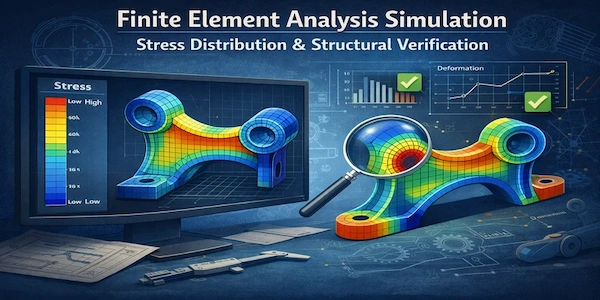
In practice? They define load cases (every possible way something could be stressed), set boundary conditions (how it's mounted, supported, constrained), pick material properties (including the ones that scatter way more than the datasheet admits), and run finite element models to see where stress concentrates. Translation: they turn a design someone sketched into math that predicts failure modes. You do this when gut feel stops being acceptable, usually around the time liability or certification enters the conversation.
Here's the thing: unlike design roles, you're not measured by how clever or fast you are. You're measured by whether you were right. Can you defend this analysis in front of a review board? Will it hold up when an auditor reads it three years from now? If something fails in the field, does your report explain why it shouldn't have, or why you warned them? The output isn't a beautiful concept. It's evidence.
FEA vs Design and Manufacturing Roles
Structural analysis sits between creation and execution. Design engineers decide what should exist. Manufacturing engineers figure out how to make it at scale. Analysis engineers? They determine whether the thing will actually work.
Compared to design, the work is narrower. But deeper. You don't get to pick the geometry or material (someone already did that, probably without asking you), and now you're stuck proving whether their choices survive reality. The challenge isn't brainstorming ten concepts. It's taking one concept and identifying exactly where the assumptions fall apart. Will this bracket yield at the bolt hole? Will it fatigue after 50,000 cycles? Will thermal expansion cause interference? You're finding the edge cases design didn't think about.
Compared to manufacturing, you operate earlier. Before anyone's optimized a production line or argued about tolerances with a supplier. Your job isn't throughput. It's catching catastrophic structural failures while they're still theoretical. The defining difference is accountability: design owns the what, manufacturing owns the how, and you own whether the thing breaks. Or doesn't.
Problems FEA Engineers Solve
The problems aren't open-ended. They're specific. Binary, even. Will this bracket yield under max load? Will this shaft fatigue before 100,000 cycles? Will the panel buckle when you bolt it down? Will deflection stay under 2mm? You're answering yes or no, with math and margin to prove it.
Most of the work is worst-case thinking. Not "does it work on average" (anyone can make something work on average). The question is what happens when the load spikes 20% higher than spec, the material comes in on the weak end of the scatter band, it's operating at -40°C instead of room temp, and the machinist held the looser tolerance because the tight one was expensive. A design that works nominally can still fail certification. Or worse, fail in the field when all the stars align wrong.
You're not measured by novelty. A "good" solution is one you can defend in a design review, one that still makes sense when someone audits it four years later, and one you'd stand behind if it ended up in a failure investigation. Confidence and margin. That's the game.
FEA Tools and Skills
FEA is the main tool, but here's the uncomfortable truth: it'll give you beautiful results even when your assumptions are wrong. Good analysts cross-check everything with hand calcs, classical beam theory, and back-of-the-envelope estimates before trusting the mesh.
You need solid fundamentals in mechanics of materials, structural dynamics, and failure theories (Tresca, von Mises, Mohr-Coulomb). The real skill is simplifying complex assemblies into models that solve efficiently without throwing away critical physics. Miss a constraint? Fiction. Oversimplify geometry? You might miss the stress concentration that causes failure.
Documentation matters. Your analysis is worthless if you can't explain it to the design team or defend it in review. The ability to interpret results and communicate assumptions matters as much as the numbers.
Who FEA Engineering Is a Good Fit For
This fits engineers who prefer precision over ambiguity. If you like clearly defined problems ("will this break or won't it") and you'd rather prove something works than brainstorm possibilities, analysis makes sense.
It fits people who can spend hours refining a mesh, realize the boundary condition was wrong, and start over without losing their mind. Patience and skepticism aren't optional. You need to question whether results are real or numerical artifacts. Attention to detail is the job.
Engineers drawn to this work prefer going deep on fewer things rather than skimming everything. You're motivated by being right, not by having your name on the concept sketch. Someone has to make sure the concept doesn't kill anybody.
Common Misconceptions About FEA Engineering
People think you "just run simulations." Wrong. Most work happens before and after the solver runs: defining loads, picking boundary conditions, interpreting whether results are real or mesh artifacts. The simulation is maybe 20% of the effort.
Another one: FEA replaces judgment. It doesn't. Invalid input, invalid output. If your assumptions are wrong, the software will happily give you beautiful, completely incorrect answers. Strong analysts use intuition and hand calcs to challenge the model.
And the big one: "analysis engineers don't influence design." When you identify a stress concentration that'll cause fatigue failure, prove a design is overbuilt by 40%, or find that a concept won't survive shipping loads, that changes everything. You're shaping what's possible.
How FEA Fits Into a Mechanical Engineering Career
You usually start with grunt work: mesh refinement, load case setup, extracting results and formatting reports. You learn how design decisions create stress concentrations, how material choices affect failure modes, and how much margin you need when theory meets reality.
With experience, you own subsystems and define certification strategy: what gets tested, what gets analyzed, what combination satisfies the regulatory authority. Senior analysts are gatekeepers. Nothing releases until you sign off on safety factors. If it fails, people look at you first.
The skills transfer well to systems engineering, technical leadership, and safety-critical industries (aerospace, medical devices, pressure vessels). Analysis teaches you that physics doesn't negotiate.
Is FEA Engineering Right for You?
This isn't about speed or creativity. It's about confidence and responsibility. If you like verifying things, questioning assumptions, and building technical arguments that survive hostile review, this might work. If the idea of signing off on safety margins doesn't terrify you (at least a little), you're probably wired right for it.
But if you need rapid iteration, open-ended brainstorming, or hands-on shop time, this will feel slow and constraining. Neither path is better; they're just different. If you're not sure which fits, a structured assessment can help before you spend two years learning ANSYS and realize you hate it.
Career Outlook & Market Data
Salary Range by Experience
Entry Level (0-2 years)
$72k - $85k annual base
Mid-Level (3-7 years)
$88k - $118k with bonuses
Senior/Lead (8+ years)
$120k - $175k+ total comp
Job Market Growth
5-7% annual growth rate
Steady, near average (US BLS: 6% avg)
~25,000 openings/year
Projected through 2032
Infrastructure investment & certification needs
Work-Life Balance
Good to Moderate (3.6/5 avg)
Typical: 42-48 hours/week
Peak seasons:
50-60 hours during certification deadlines
Regulatory reviews can be time-intensive
Job Security & Demand
Stable (4.2/5 rating)
Critical across regulated industries
Key stability factors:
• Regulatory compliance requirements
• Complex engineering judgment needed
• Lower automation risk than drafting
Remote Work Flexibility
Hybrid/Remote (22% fully remote)
Typical: 1-2 days on-site per week
On-site requirements:
• Validation testing coordination
• Design reviews with stakeholders
Analysis work highly remote-compatible
Career Progression Paths
Technical track (72%)
• Senior Analyst → Principal/Staff
• Technical Fellow or Expert roles
Management track (28%)
• Team Lead → Analysis Manager
• Director of Structural Engineering
Data sourced from Bureau of Labor Statistics (Civil/Structural), Glassdoor (FEA Engineer), and structural engineering salary surveys (2025-2026)
What to Expect From FEA Roles
Structural analysis engineers work across industries where structural integrity is critical, from aerospace to civil infrastructure. Highest concentration is in defense, automotive, energy, and regulated industries requiring certification.
Top Industries
- Aerospace & Defense - Boeing, Lockheed Martin, Northrop Grumman (29% of roles)
- Automotive & Transportation - Ford, GM, Tesla, Rivian (23% of roles)
- Energy & Power - GE Vernova, Siemens, nuclear utilities (14% of roles)
- Consulting & Engineering Services - ANSYS, Altair, specialized FEA firms (12% of roles)
- Civil & Infrastructure - Bechtel, Fluor, AECOM (11% of roles)
- Industrial Equipment - Caterpillar, John Deere, heavy machinery (8% of roles)
- Medical Devices - Medtronic, Stryker, implant manufacturers (3% of roles)
Company Categories
- Large Corporations - 10,000+ employees, dedicated analysis departments
- Engineering Consultancies - Specialized FEA services, multi-industry clients
- Defense Contractors - Rigorous certification, long development cycles
- Software Vendors - ANSYS, Dassault Systèmes, application engineering
- Automotive OEMs - High-volume production, crash safety focus
- Energy Companies - Power generation, oil & gas, pressure vessels
- Government/Research Labs - NASA, DOE, university partnerships
Company Size Distribution
27% Mid-size (100-999)
14% Small (10-99)
11% Consultancy/Startup (<10)
Top Geographic Markets
Germany (automotive, manufacturing)
United Kingdom (engineering firms)
France (aerospace, energy)
India (engineering services)
Remote Work Trends
58% Hybrid (1-2 days office)
27% Primarily On-site
Analysis work is highly remote-compatible
Team Structure
Cross-functional: Design, testing, certification
Report to: Analysis Manager or Chief Engineer
Matrix structure common in large orgs
Employment data from LinkedIn (FEA Jobs), Indeed (FEA Engineer), and structural analysis recruiting data (2025-2026)