Mechatronics & Robotics as the Integration Layer of Mechanical Engineering
Mechatronics is where hardware meets logic. Engineers in this field don't just design machines; they make them behave, coordinating motion, sensing, and control across the messy boundary between physical and digital systems.
What Mechatronics & Robotics Engineers Actually Do
Mechatronics engineers design machines that move – not just theoretically, or in static CAD drawings, or through computerised stress analysis. Machines that really do move – repeatably, on demand – and don't catch fire or go wonky within an hour.
This post is about the hard part of making things do things. We started off designing some hardware, but once we had motors, wire sense switches, and set up a feedback loop, things moved into the world of PID controllers, noisy encoders, stuttering actuators going slow, timing problems that only showed up when everything was running, and generally making mediocre hardware do what you want it to.
People often get worked up about how pretty CAD is and how cleanly FEA worked, but in the end none of that means much. What does matter is that it works when you tell it to work, every time, for cycles, without loosing its mind or falling apart. That is the job.
How Mechatronics & Robotics Differs From Design and Analysis Roles
Design engineers shape the geometry. Analysts then check that it won't break. Mechatronics engineers then make it do something when you power it.
When moving from design work to mechatronics, creativity is constrained but scope increases. Design work involves creativity when selecting a form that serves a function. In contrast, mechatronic systems are created from a wide variety of technologies and all of these need to be connected and interact harmoniously. While initial problems can be solved in isolation – i.e. a motor can be chosen and a sensor selected in the time it takes to design a shape to represent the final work – as each component is integrated into a complete system, timing and interaction become critical issues that require empirical, real-time feedback to debug. It's not possible to solve such problems in a CAD environment.
Compared to analysis, the work is messier. Way messier. A perfectly designed linkage can vibrate itself to death if the control gains are wrong. A well-tuned PID can fail if the sensor drifts 2%. The work of a mechatronics engineer is to juggle all of these competing requirements. Mechatronics engineers inhabit the intersections of Mechanical, Electrical, and Software engineering, and as such rarely solve one type of problem in isolation.
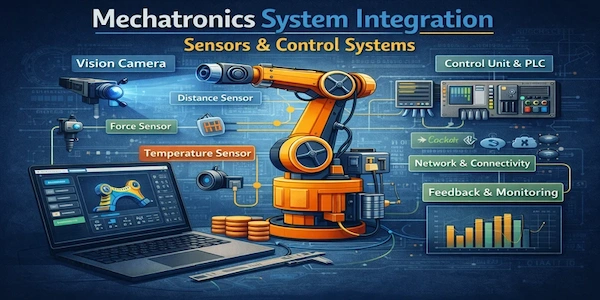
The Types of Problems Mechatronics & Robotics Engineers Solve
Mechatronics problems often hide in plain sight. A motor is overheating. Is the problem mechanical friction in the rotor or stator, electrical resistance in the windings, a thermal limit in the motor housing, or even something as simple as a control loop running too aggressively? The answer is usually yes, all of those are relevant, and then some.
It feels like I skipped over some crucial real-world debugging and tuning. Specifically: getting motion control more solid and less wobbly, mysterious vibrations that aren't in simulation, and random noise in sensors that shouldn't have any. Also, timing issues where things don't happen in sequence in time (like arm commands being delayed by 50ms), and emergent behaviors that don't occur when individual components are tested in isolation.
This project challenges one to identify causes of oscillations or instable motion across hardware, embedded code, and control strategy. Sometimes the solution is a simple hardware tweak such as a stiffer mount or better bearings. In other cases the tweak may be a well-tuned PID gain that was running too high. Occasionally simple changes such as re-routing cables will prevent them from picking up interfering signals. Understanding what is happening in all three realms and weighing their trade-offs is crucial to implementing an optimal fix.
Tools and Skills Used in Mechatronics & Robotics
The Mechatronics Engineer has a more varied toolset than most traditional "disciplines." When I work as a Mechatronics Engineer, I use CAD packages, oscilloscopes, multimeters, logic analyzers, and a whole host of other lab tools, in addition to design and modeling software such as MATLAB/Simulink for control modeling, programming languages such as embedded C or Python for low-level implementation on microcontrollers or other embedded devices, and of course, lab workbenches cluttered with half-assembled prototypes in various states of disrepair with wires looking unacceptably bad until one realizes the debugging process behind them.
Why do we need dynamics? Because if you want to talk about control theory, you need to know what you plan on controlling first. Why do you need to know how to wire together some electronics? Because if you want to write a control program, you need to know how to read the datasheet for a sensor, and how to wire it up to make it work correctly, and how to condition the signal so that your AD converter can read it in a reasonable way. Why do you need to know a little bit of control theory (PID, state feedback, stability margin)? Because if you're going to write a control program, you need to be able to write a decent PID loop, and know how to use a state feedback controller, and measure the stability margin of a system. Why do you need to know enough programming to write a control loop, and debug timing issues? Because if you're going to write a control program, you can quickly come to the point where you have a great theory of how the system should behave, but your actual system is subtly misbehaving, and you need to debug it. And simulation helps, but is not a guarantee that you'll find out all the ways in which your actual system will differ from your model.
In addition to the technical details required to assemble a functional, state-of-the-art motion system, considerable translation skills are required to explain to mechanical designers why a elegantly designed linkage will not interface with cost-effective motor packages available in the market, or to explain to software engineers why their theoretically optimal control scheme will destroy the gearbox in approximately 3 minutes of operation. Integration work is communication work.
Who Mechatronics & Robotics Is a Good Fit For
Projects in this area appeal to those who want to apply their engineering skills beyond the pages of a design manual or the simulations that drive product development. Instead, one gets to work with physical systems that respond interactively in real time. It is very rewarding, because while one may have complete mastery of the electronics or software, ultimately the project must integrate successfully, and that is what is truly satisfying. Of course, then one has to debug the whole system at night, but that's another story. Mechanical systems, hardware and firmware for sensors, and timing issues all play a role in this field.
For many engineers, mechatronics is a great fit because they don't have to be a deep expert in a single field. While you still need to have enough knowledge of mechanical engineering to understand how a system is going to behave physically, enough knowledge of electronics to understand how to connect different parts of a system to gather data, enough knowledge of control systems to design and tune a control loop to get the performance that you want, and enough knowledge of software engineering to write code that is embedded on a microprocessor to run that control loop, you don't have to be the world's greatest master of any of these different disciplines. For many engineers, the fact that they are a jack-of-all-trades and don't have to try to understand every single different nuance and subtlety within a particular field, while instead being able to see how all of the different fields fit together to get a complete system is key. This means that curiosity about how different disciplines of engineering interact is much more important than being the ultimate expert in a particular field. In addition, as anyone who has dealt with a multi-discipline problem knows, patience in trying to debug something and track down a bug in something that is in between different fields is incredibly important, because it's rarely something that you fix on the first try.
If you like narrowly defined problems with sharp boundaries between disciplines with clear and unambiguous success criteria, then other specializations may seem less sloppy than mechatronics. But as a mechatronics engineer, you will encounter countless trade-offs: how to design a power supply for a high-voltage piezoelectric stack; how to mechanical design a mechanism to optimize its compatibility with the electronic controls that will command it; and how to tune a control algorithm to allow the mechanical system to perform optimally. If you find joy in and have patience for such a set of ambiguous, interrelated problems, then mechatronics might be the profession for you.
Common Misconceptions About Mechatronics & Robotics
A common misconception about mechatronics engineers is that they must be programming rockstars. While code is certainly important, it is typically limited to embedded control implementations, and not grand software architectures that software engineers can spend years studying and perfecting. One must be functionally proficient in C or Python, not fluent. Functional means you can write a control loop, or debug timing sensitive code to fix a problem, as opposed to understanding the nuances of higher level algorithms and architectures that rarely if ever apply to mechatronic systems. The programming bar exists, but it's not as daunting as people make it out to be.
The common belief that robotics involves a lot of artificial intelligence and autonomous behaviour is also often held to be true. While it is true that some of the most challenging AI problems exist in robotics, for most mechatronics engineering roles the challenge is not to build something that can learn and make decisions. Rather, it is to design and develop industrial equipment, medical devices or consumer electronics that repeat the same action over and over again to a very high standard of precision. Yes, it may sound dull in comparison to the potential of autonomous behaviour, but the challenge of reliable motion control occurs far more frequently in practice.
The most damaging misconception about mechatronics is that it is less demanding for the engineer than traditional mechanical engineering. In fact, the opposite is true. A mis-tuned controller can very quickly destroy expensive hardware. Integration mistakes can cost even more expensive hardware by short-circuiting it (like shorting out a $15,000 motor). Debugging a problem that affects multiple domains simultaneously requires a very systematic approach, integrating knowledge of mechanical dynamics, electrical systems, and software timing all at the same time. The increased demand for the engineer is not less, but more complex.
How Mechatronics & Robotics Fits Into a Mechanical Engineering Career
Early at Rosie Robotics has entry-level engineers work on building, validating, tuning, debugging and testing entry level functions. This helps ensure that as engineers move up the ladder to more "glamorous" tasks like developing innovative concepts for robot arms and hands, they have a solid grasp of what actually works and what does not, translated from abstract understanding of the system to physical reality. Early at Rosie exposes its engineers to the details that make a difference for grounding, shielding, timing, thermal and many other aspects of practical engineering that textbooks rarely bother to include in footnotes. As engineers develop at Rosie, they apply these lessons to prevent problems that others face before they even occur.
As you get more experience, you take ownership of entire subsystems, make hard integration decisions, and influence both the mechanical design and control strategy early in the development cycle before someone does something stupid with the geometry or selects a motor that has the wrong torque profile for the required power and functionality with acceptable power and thermal consumption. Senior robotics engineers focus on the system architecture, the robotics technical leadership role, or "horizontal" projects that cut across multiple functions and require effective coordination of the mechanical, electrical, and software groups to meet system-level objectives that may not be served by optimal local design objectives.
My mechatronics experience is particularly relevant to the automation, advanced manufacturing, and product leadership sectors. It is valuable in any field where a systems perspective is more important than in-depth knowledge of a specific area. Companies today have complex systems that span multiple disciplines, and need people with a broad perspective that can diagnose and fix problems that don't fit in a single box. This kind of problem solving ability is relevant to many industries, and is not limited to traditional robotics or automation environments. With the increasing integration of mechanical, electrical, and software components into complex products, the need for people who can debug these systems from a holistic perspective is growing. By identifying and addressing problems that involve the mechanical dynamics of a system, the sensor and calibration issues, and the timing and tuning of software control loops, I am able to bring value to a wide variety of industries and roles.
Is Mechatronics & Robotics the Right Path for You?
Most mechatronics is not about beautiful models or clean problem definition, but rather about getting the integrated system to actually work, and then, as it comes close to working, figuring out why it does not work. This is done by a process of debugging that encompasses all the possible categories of error in mechatronics, from mechanical assembly through to sensor calibration, and on through to control law. While some may find this process of repetitive integration challenging but rewarding, others will find it soul-destroyingly dull and overwhelming. Ultimately, your experience of mechatronics as a discipline will be shaped by your personal attitude to this type of work.
Is debugging multi-domain failures (yes, that does sound draining) interesting to you? Or, does making disparate systems work together as a whole to create a new system sound more interesting than fine tuning performance within a defined domain? If you made the latter choice, don't worry about it – in the end you'll be spending way more time designing and building systems than you will developing a sales pitch. If you can't decide whether you're more interested in the engineering challenges of working with systems in motion versus systems at rest, then there are legitimate engineering contributions in both areas. But don't waste years becoming an expert in robotics software frameworks and robotics architecture only to find out that you're actually really good at stress analysis or thermal design. Use the Career Assessment Tool to get a grip on what options are out there before you make some expensive decisions.
Career Outlook & Market Data
Salary Range by Experience
Entry Level (0-2 years)
$68k - $82k annual base
Mid-Level (3-7 years)
$85k - $115k with bonuses
Senior/Lead (8+ years)
$118k - $165k+ total comp
Job Market Growth
9-12% annual growth rate
Faster than average (US BLS: 6% avg)
~18,000 openings/year
Projected through 2032
Driven by automation & EV expansion
Work-Life Balance
Moderate (3.2/5 avg rating)
Typical: 43-50 hours/week
Peak seasons:
50-60 hours during product launches
Hardware debug can extend hours unexpectedly
Job Security & Demand
Very Stable (4.3/5 rating)
High demand, low supply of talent
Key growth drivers:
• Factory automation expansion
• Robotics market growth (18% CAGR)
• Cross-industry applicability
Remote Work Flexibility
Hybrid model (8% fully remote)
Typical: 2-3 days on-site per week
On-site requirements:
• Hardware testing & integration
• Prototype builds & debugging
Design work can be remote
Career Progression Paths
Technical track (64%)
• Senior Engineer → Staff/Principal
• Systems Architect roles
Management track (36%)
• Team Lead → Engineering Manager
• Director of Robotics/Automation
Data sourced from Bureau of Labor Statistics (Mechatronics Engineers), Glassdoor (Mechatronics Engineer), and robotics industry salary surveys (2025-2026)
What to Expect From Mechatronics & Robotics Roles
Mechatronics engineers work across industries where automation, motion control, and intelligent systems drive competitive advantage, from manufacturing floors to medical devices to consumer robotics.
Top Industries
- Industrial Automation & Manufacturing - Rockwell, Siemens, ABB, Fanuc (32% of roles)
- Automotive & Mobility - Tesla, Rivian, Waymo, autonomous vehicle systems (21% of roles)
- Consumer Robotics & Electronics - iRobot, Boston Dynamics, DJI, consumer drones (14% of roles)
- Medical Devices & Surgical Robotics - Intuitive Surgical, Stryker, Medtronic (13% of roles)
- Aerospace & Defense Automation - Lockheed, Boeing, UAV systems (9% of roles)
- Warehouse & Logistics Automation - Amazon Robotics, Kiva, automated fulfillment (7% of roles)
- Agriculture & Field Robotics - John Deere, autonomous farming equipment (4% of roles)
Company Categories
- Automation OEMs - Industrial control systems, robotics platforms
- Tech Startups - Emerging robotics, autonomous systems
- Automotive Manufacturers - Electric vehicles, automated driving systems
- Medical Device Companies - Surgical robots, prosthetics, rehabilitation systems
- Consumer Electronics - Smart home devices, drones, robotic assistants
- System Integrators - Custom automation solutions for factories
- Research Labs - University labs, government R&D, DARPA projects
Company Size Distribution
29% Mid-size (100-999)
21% Startup/Scale-up (10-99)
12% Small/Boutique (<10)
Top Geographic Markets
United States (automation, AI)
Germany (industrial automation)
China (manufacturing robotics)
South Korea (electronics, robotics)
Remote Work Trends
64% Hybrid (2-3 days on-site)
28% Primarily On-site
Hardware work requires lab time
Team Structure
Cross-functional: Mechanical, electrical, software
Report to: Systems Lead or Engineering Manager
Integration-heavy collaboration
Employment data from LinkedIn (Mechatronics Jobs), Indeed (Robotics Engineer), and mechatronics industry recruiting data (2025-2026)