Materials & Process Engineering: Bridging Design Intent and Physical Reality
Without intention, you are designing the geometry of the PDN. More importantly, you are designing the PDN to survive the extremes of manufacturing variation, part to part variation, and reality vs. datasheet specification. This article describes why these three factors never seem to align.
What Materials & Process Engineers Actually Do
The first cracking (and subsequent failure) of a titanium bracket has been discovered at 6,247 cycles – short of the predicted 12,000 cycles. Although production documentation will confirm proper heat treatment of the bracket material, failure to achieve design strength is nonetheless a major concern. With 1,200 units already manufactured and first deliveries scheduled for three weeks plus this Monday when the failure was found, a crunch is developing to fix the problem before more parts shatter.
We didn't create the bracket design, that was done previously by the engineering team. Our role was to perform a root cause to understand why the physical test didn't meet the expected design performance. Was the heat treatment process deviating from the specification? Is there a microscopic defect that didn't get caught in inspection. Are the test conditions realistic for how the bracket would actually be used. Our job was to go step by step through all of the processing steps, (heat treat, forming, machining, surface treatment) to find the root cause of failure and identify how the datasheet performance deviated from reality.
This work is divided into two primary tasks: prevention and diagnosis. Initially, we work with designers *before* designs are released to factory, advising them as to whether certain superalloy types are even realistic choices based on supplier lead times and process qualification (e.g. "Yes, you can use this high-temperature alloy, but it will take 14 weeks for supplier to deliver, and process qualifying the weld will add ~$40k to project cost"). We solidify how various materials will be processed (heat treatment temp & time, welding processes, surface coatings, NDE methods, etc.), turning engineering concepts into reality within the constraints of part manufacturability. Secondly, we work in production to diagnose why a part does not perform as per prototype, why welds have cracked, why certain areas of the surface have variable quality, etc.
This book turns a common assumption on its head: that materials act exactly as described in their datasheets. The reality is that there is always a gap between the two, and it is the engineer responsible for finding the cause and working around the consequences of that discrepancy.
How Materials & Process Engineering Differs From Other Mechanical Roles
Most engineers can pull out relevant numbers from datasheets for materials they haven't even seen hardened before SolidWorks. Materials & process engineers cannot. Because the datasheet says 7075-T6 aluminum has 570 MPa yield strength and that is fine for the materials engineer, but the design engineer needs to know that is for bar stock in the T6 condition tested at room temperature in uniaxial tension. What is the strength after welding for example? What if the part was stored in a truck at 90°C for 3 months before being assembled? What is the strength after 5000 hours at elevated temperature in service? The assumed typical properties can be lethal. The small change in process from one batch to another, that the production personnel do not even consider noteworthy, could have a large effect on the design.
The requirements for data and analysis go well beyond simple technical depth - they must be verifiable and defendable NOW, not just six months from now. What happens when someone asks why part from supplier B fails while part from supplier A does not? Follow back the lot tracing from receipt, through furnace calibration records and heat treatment time-temperature profiles to property test data. Or consider that instead of assuming uniform properties for structural analysis you find that heat lot #A2471 has a yield of 950 MPa while lot #B1803 has a yield of 870 MPa, although they were purchased from the same supplier. Analysis assumes that materials are isotropic and account for grain direction, weld microstructures and material defects.
A key difference is that you are predicting how a system will behave under test conditions which you cannot fully recreate in laboratory testing validation. Therefore, you validate process validation by ensuring that material microstructure has been properly characterized and that sufficient numbers of full scale, representative test articles have been tested. All of this needs to be documented.
The Kind of Problems Materials & Process Engineers Spend Their Time Solving
Stress corrosion cracking has appeared on a surface on a stainless steel part after 3,200 hours of operation. Cracks occur at several locations around the circumference, often starting at the peak of the grinding marks left from an abrasive grinding wheel. Corroded regions exhibit intergranular corrosion with a penetration of approximately 0.8 mm. The part is specified as 316L and should have adequate corrosion resistance. However, in an attempt to produce a part ready for assembly earlier in the production stream, an abrasive grinding wheel was used to produce a surface finish with unacceptable stress-induced micro-cracks. Rather than replacing the existing material with a different one, a finishing process is needed to produce micro-stress less stressful than that created in the current grinding process. Fortunately, production has only processed 400 parts using the existing method. Unfortunately, this is not a simply classified problem.
Here's a reality check on the next consequence of your selected fix. Switch from cast to forged to increase the strength of a part? The casting-process changes in aluminum from cast to forged to enhance the strength of the part introduces changes in the grain flow that in turn affects machinability which in turn requires new tooling. The incremental cost per part is now $18 per part. Use a lower-temperature heat treat to reduce part distortion? It's only 5% stronger, and after a few trials fails the test article qualification requirements that forced a redesign to add thickness to meet weight specs. Preheat to 200°C to stop weld crack formation? The heat-affected zone is now softer, dropping fatigue life by 30%, bringing you right back to redesigning the weld joint.
Another time dimension to consider, is that of when failure is expected to occur, be it 50,000 thermal cycles, 15 years in the field exposed to UV radiation, or 18 months of seemingly flawless service. Even after subjecting a part to rigorous acceptance testing, failure is ultimately encountered, here after only 18 months. Through reverse engineering of the failure event (inspection of fracture surface, microstructure evaluation, etc.) the necessary design of new processes to improve durability can begin.
What are the REAL questions you are trying to answer with the submitted Weld Procedure Specification? Are you trying to determine if your weld procedure will consistently produce adequate penetration across the various part thicknesses and will not develop hot cracks. Are you trying to determine if the selected coating will withstand 2,000 hours of salt fog testing and remain adherent to the subsequent thermal cycling. Are you trying to establish the probability of achieving minimum hardness for a specific heat lot given the observed average grain size and heat lot to heat lot variations. Show your work and supporting data! The specified procedure must be practical and not so conservative as to make the part(s) unacceptable for fabrication.
Tools and Skills Used in Materials & Process Engineering
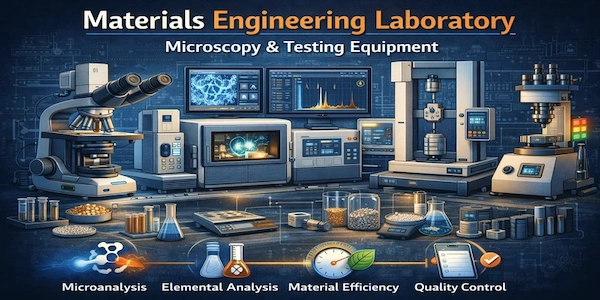
Our work involves more time with microscopes, hardness testers, and fractography analysis than with design software. The primary tools are material databases such as MatWeb and MMPDS along with various test equipment including tensile, fatigue, and impact chambers as well as corrosion test fixtures. There are also several methods for failure analysis including SEM for fractography, EDS for chemistry, and XRD for phase ID. The emphasis is on verification, and data is given more weight than idealized models because it is recognized that material behavior cannot be simulated exactly.
For engineers, working in a lab is just part of the job. However, to be truly trusted at your organization, having in-depth knowledge of key standards related to tensile and fatigue testing is what can help you stand out from the crowd. Knowing the nuances of ASTM E8 for tensile testing versus ASTM E466 for fatigue testing, the differences between SAE AMS spec 4923 versus 4925, and being NADCAP AC7102 accredited are all crucial to prove proficiency in testing materials against specifications that satisfy organizations with high-stakes regulatory risk.
Technical writing is under scrutiny. Every material choice, every process change, every failure analysis is documented in reports read by design engineers questioning your conclusions, quality auditors checking your company's compliance, and (unfortunately) lawyers reviewing your work for liability. Vague writing will be challenged. Omissions in recorded data will be rejected.
One of the hardest things to do in mechanical design and development is to tell when your test data is actively deceiving you. Data from well designed laboratory test specimens shows high reliability in failure under repeated loading, while samples taken off the production line without exception break in half the number of cycles. How do you distinguish between the level of reliability in your test methods and the occasional anomaly that can lead you astray? The ability to do this defines a technician from an engineer.
Who Materials & Process Engineering Is a Good Fit For
Are NTSB failure reports entertaining reading? Are microstructures of failed parts fun to look at? Are you immediately skeptical of numbers of materials' properties in the tabular format (i.e., are round numbers scary to you?) and think that "it's the same stuff but made by a different manufacturer" - and thus that "it should behave similarly"? (Though probably "similarly poorly", since presumably the poorly behaving material is no longer being made.)
This work has a particular sort of appeal to mechanical engineers, as it involves failure mechanisms and avoiding field failures rather than designing processes to get as fast or as wide of a window as possible as an electrical engineer might. People enjoy coming up with arguments of three hand-slapping-foreheads moments of brilliance to explain why a window might be too tight. And yes, they enjoy being the party pooper who says "it passed the acceptance test" is not the same thing as "it won't fail in service", and are generally happy to explain, and argue with, people who do not want to hear this.
This course is not for those who thrive in a fast-paced environment expecting to generate multiple innovative ideas, quick results, and high visibility, all while delivering high-quality creative solutions. This course is not for those who work independently, with little oversight, and who are not eager to regularly defend design decisions in collaboration with cross-functional teams.
If you've ever looked at a fracture surface under SEM and thought "that's beautiful", can prevent disasters that nobody suspected were going to occur, produces engineering that is still going to be intact and functional twenty years from now, this is the kind of engineering that you will find fulfilling.
Common Misconceptions About Materials & Process Engineering
"It's about memorizing material properties."
Not according to the datasheet, which is only a starting point. The datasheet says 6061-T6 has a yield of 276 MPa for bar stock at room temperature, but we have to look at the post-weld strength, as well as the strength after 5000 hours at 95°C. Real engineering involves more than just examining the property table.
"Materials engineers only get involved after failures."
Reality #3 – The best work is upstream during material selection and failure analysis to keep poor materials and questionable designs from ever showing up at the tooling design review and prevent failures by simply questioning a few assumptions during design review.
"You need a PhD in materials science."
No. Most industry needs people who can read heat treatment documents, understand the deviations from specification and give logical explanations for failures caused by a 20° C change in processing temperature. Some industry needs people with advanced degrees for R&D but most industry hires people with applied knowledge of heat treatment processes. They can apply knowledge of specifications, standards, testing, and organized troubleshooting methods.
"It's slow, academic work with long timelines."
I've seen some fascinating work go on here. We'll be in the middle of a three month corrosion test, and then production will come back online in four hours and someone will scramble to determine the root cause as to whether it was the material, process, or design that failed. Real, meaningful work, but not work that will look good in a recruitment brochure. No constant visible victories here.
How Materials & Process Engineering Fits Into a Mechanical Engineering Career
Year 1-3: Run the qualification testing designed by others, perform tensile testing, hardness surveys on metallography samples, and failure analysis which is then reviewed by senior materials engineers for unsupported conclusions. The junior materials engineer is not qualified to run the development of materials for the program or to certify suppliers or approve substitutions.
Year 4-8: You will be responsible for selecting material selections for the various systems (e.g. propulsion, structures, thermal protection). You will develop and write test plans, qualify suppliers, perform failure analysis from field data and present engineering findings to the program manager to determine whether it is best to continue flying deteriorating structures or to stop production while engineering fixes are developed. As with the previous stages, there is still the possibility for mistakes but the responsibility for errors will be greater as you will own the development of the vehicle.
After Year 9 you either take on a leading role in engineering materials selection (as a Chief Materials Engineer defining company policies on materials choice and reviewing critical design decisions for conformance to those policies) or move into Quality (failure analysis, design of experiments, and design of investigations) or into supplier development, management, or other related engineering functions. Alternatively, you could specialize in Corrosion Engineering (pipeline and chemical processing industry), or in welding metallurgy, or in failure analysis consulting. A broad set of skills that can be easily applied to many industries. The aerospace industry often requires fracture mechanics engineers, medical devices requires biocompatibility engineers, the automotive industry requires fatigue test engineers. Once you can apply rigorous engineering to predict how engineering materials will behave under adverse or extreme conditions, you will find most industries relatively easy to understand.
Is Materials & Process Engineering Right for You?
Are you facing a similar decision? The part meets all the key specifications, testing results back up the design for 18,000 fatigue cycles with only two weeks to go before product launch. The specifications called for 15,000 cycles, but you have the potential to increase life to an impressive 25,000 cycles with a design change that requires re-tooling and a five week slip in launch. The question is, do you put it out now at 18,000 cycles, or push to increase the margin of safety. Marketing is looking for a specific launch date. What's your decision?
Does 18,000 SH mean to you "ship it because 18000 is on spec"? Or does it mean "what's the risk of field failure and is a 20% margin sufficient given variability in data between batches"? For this project, Materials & process engineering is the showstopper, and a very conservative, data-driven mindset is rewarded. Once you get past the scheduled delivery pressure, it boils down to "we don't have enough evidence."
I wrote this report for people who enjoy doing a lot of detective work but aren't designers, who prefer to work with physical evidence or simulations rather than abstract design concepts, who are happy to be the "no" person in a world that wants more "yes"es, and who enjoy deep expertise in a relatively narrow field.
This is not for someone/solution that requires immediate feedback or results, assumes there is a single answer to a problem, requires siloed work across functions, or enjoys creating something new as opposed to working hard to ensure something you already have doesn't fail.
Curious about how your product development process stacks up against your thinking? A structured assessment can help make that clear.
Career Outlook & Market Data
Salary Range by Experience
Entry Level (0-2 years)
$70k - $82k annual base
Mid-Level (3-7 years)
$85k - $115k with bonuses
Senior/Lead (8+ years)
$115k - $175k+ total comp
Job Market Demand
4-6% annual growth rate
Steady (US BLS: 6% avg)
~18,000 openings/year
Projected through 2032
Aerospace, medical device, & advanced materials driving demand
Work-Life Balance
Good (3.9/5 avg rating)
Typical: 40-45 hours/week
Peak seasons:
45-50 hours during failure investigations
Urgent production issues may require immediate response
Job Security & Demand
Very Stable (4.3/5 rating)
Critical specialized expertise
Key growth drivers:
• Advanced materials development
• Quality & regulatory compliance
• Difficult to offshore or automate
Remote Work Flexibility
Hybrid common (10% fully remote)
Typical: 3-4 days on-site per week
On-site requirements:
• Lab testing & microscopy work
• Production floor investigations
Physical access to parts/processes required
Career Progression Paths
Technical track (65%)
• Senior Materials Engineer → Principal
• Technical Fellow or Chief Materials Engineer
Management track (35%)
• Team Lead → Engineering Manager
• Director of Quality/Manufacturing
Salary and job growth data sourced from Bureau of Labor Statistics (Materials Engineering), Glassdoor (Materials Engineering), and materials science salary surveys (2025-2026)
What to Expect From Materials & Process Engineering Roles
Materials & process engineers work in industries where material performance is mission-critical. Geographic concentration is highest in manufacturing hubs and R&D centers with strong aerospace, automotive, or medical device presence.
Top Industries
- • Aerospace & Defense - Boeing, Lockheed Martin, Raytheon (26% of roles)
- • Automotive & Transportation - GM, Ford, Tesla (20% of roles)
- • Medical Devices - Medtronic, Stryker, Boston Scientific (18% of roles)
- • Metals & Manufacturing - Alcoa, ArcelorMittal, Carpenter (14% of roles)
- • Energy & Oil/Gas - GE, Baker Hughes, Schlumberger (10% of roles)
- • Semiconductors & Electronics - Intel, Applied Materials (7% of roles)
- • Chemical & Process Industries - DuPont, Dow, 3M (5% of roles)
Company Categories
- • Large Corporations - 10,000+ employees, dedicated materials labs
- • Mid-Size Manufacturers - 500-10,000 employees, diverse projects
- • Testing & Certification Labs - UL, SGS, specialized expertise
- • Materials Suppliers - 50-5,000 employees, technical sales support
- • R&D Facilities - National labs, university partnerships
- • Consulting Firms - Exponent, Failure Analysis Associates
- • Government/Defense - NASA, DOD, regulatory compliance
Company Size Distribution
29% Mid-size (100-999)
18% Small (10-99)
5% Startup (<10)
Top Geographic Markets
Germany (automotive, metallurgy)
Japan (advanced materials)
China (manufacturing scale)
United Kingdom (aerospace, research)
Remote Work Trends
42% Hybrid (3-4 days office)
50% Primarily On-site
Lab & production floor access required
Team Structure
Cross-functional: Design, Quality, Manufacturing
Report to: Chief Engineer or Quality Director
Often work independently as SMEs
Employment data from LinkedIn (Materials Engineering), Indeed (Materials & Process), and materials science employment surveys (2025-2026)