Manufacturing & Production Engineering as the Execution Layer
Manufacturing & Production Engineering is where the rubber meets the road for your mechanical design: it is the discipline responsible for turning a design into a repeatable, reproducible and reliable process to create items at repeatable cost, in high volume and to proper quality levels.
What Manufacturing & Production Engineers Actually Do
From design to reality at scale, our Manufacturing & Production Engineers translate finalized or partially developed design concepts into repeatable, reliable and cost-effective methods of production. Not in a test tube or a small scale experiment. Day in, day out, thousands of times.
Identify repeatable manufacturing methods to design manufacturing and create manufacturing documentation such as manufacturing process design, fixture and tooling design, process parameter documentation and work instructions. Validate the manufacturability of the part to verify the design can be repeatably and reliably produced within specified tolerances, now and in the future while mitigating the effect of part life, shift effect and batch to batch effect due to material property variations.
Failure modes that the manufacturing engineers who will assemble or install the part never think of. Misalignment during assembly. Tolerance stack-up in a "perfectly designed" part that makes installation impractical. Machine limitations that are overlooked during prototype testing. Supply chain realities that are unacknowledged by design engineers. Once defects are identified or yields fall below acceptable levels, it is up to Designers/Design Teams to determine the root cause and implement fixes before lines are ever put into production. All while ensuring that fixes do not negatively affect quality or safety.
Why Manufacturing Is the Execution Layer
Theory is great until it meets reality. This is where all of the assumptions made about how a design should be manufactured get tested and found to be either correct or woefully inadequate. The job of the manufacturing engineer is to ensure that the product can actually be made.
While the design team may be perfecting the geometry of a part or product, there is always the reality check to come – will it actually be possible to manufacture the design as intended on available tooling, without defects, and within a reasonable assembly time. Unfortunately, this perspective is usually left to the manufacturing engineers to deliver an unpopular truth.
The execution layer is where products don't loose by failing in CAD, they loose by failing in production, failing in assembly, failing in the field after six months of slowly increasing manufacturing variation. The role of the manufacturing engineering execution layer is to check if the product is being built to the design intent, and if not, to adjust the design intent to meet current manufacturing capabilites.
How Manufacturing & Production Engineering Differs From Other Mechanical Roles
This book does not aim to introduce entirely new design concepts, elaborate on complex theoretical equations, or expound utopian models that only work under idealized scenarios. Instead, the book aims to consistently apply existing design strategies at scale and under harsh constraints, using real-world scenarios as inspiration.
While Design has a longer runway for innovation, Manufacturing Engineers are working with constrained budgets, very little flexibility, and limited room for error. Any change costs money, impacts schedule, requires rework to new tooling, and full re-Validation. Small mis-steps early in the product development process can quickly blossom into major catastrophes by release week.
My experience in Analysis is quite different from my experience in Manufacturing. In the Analysis world, one seeks to optimize under assumptions of ideal variability, near-infinite repeatability, and performance under nearly perfectly controlled conditions. In Manufacturing, one seeks performance under high variability, less-than-ideal repeatability, and with substantial uncertainties in achieving robust performance even after initial success. In other words, work optimised for Analysis rarely suffices for Manufacturing. The first succeeds on the first try; the second requires thousands of tries, under poor working conditions, by tired operators, with deteriorating equipment, on different materials supplied by sometimes uncooperative suppliers. Different problems.
Management differs from manufacturing engineering in that a manufacturing engineer is actively involved with processes, data, equipment and failure modes whereas when production fails a manager is expected to differ from a manufacturing engineer in that when production fails they stop it for a reason and then fix the reason for its failure.
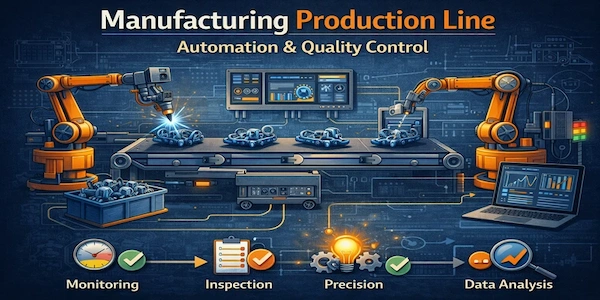
The Kind of Problems Manufacturing Engineers Spend Their Time Solving
These are problems that only reveal themselves at scale. That part that fit so perfectly in your prototype has a 15% defect rate in production. What contributed to the simplicity of the part design in prototyping may introduce variability in production due to material variation, machine drift, assembly sequence, and operator technique.
Reduce defect rates, remove bottlenecks and improve cycle times without introducing new problems to fix. Stabilise processes that seem to slowly drift out of control. These are typical problems in a manufacturing environment, and typically multifaceted: the effect of materials and machines through to people and environment. But it's likely that there are also factors at play that you have not even considered. As with any problem solving activity, you will need to analyse a lot of noisy data to identify likely multiple root causes. And develop solutions that achieve competing objectives - quickly, at an acceptable cost, with proper safety, and with proper quality.
Progress is measured by throughput, yield, uptime and repeatability. How smooth, how fast, how reliable and how consistently can you make something as you scale up? And can you do it in a way that is somewhat efficient, on spec, on time, safely and without damage?
Tools and Skills Used in Manufacturing & Production Engineering
Process design, tolerance analysis with real manufacturing variation, fixture and tooling design, a statistical thinking perspective (this is about distributions and trends, not individual data points), CAD used primarily for designing tooling, jigs, and line layouts; you are designing what builds the product, not the product itself.
Analysis, SPC and root cause methodologies such as 5-Why or fishbone diagrams are integral to our day-to-day work and are often seen as powerful tools for problem solving. While these methods can be very effective in helping us identify and fix defects, they are not always as conclusive as we would like. Sometimes they provide valuable new insights to inform our decisions; other times they appear to formalise what we already know to be true. In these cases, an effective solution can simply be to stop overcomplicating the problem.
While the term "factory simulation" is used less often, concepts and practices found in FMSi are well-known to manufacturing practitioners. These include using Lean manufacturing methods to eliminate waste, reduce cycle time between steps and implement ongoing improvements. These efforts often utilize Value Stream Mapping, Kaizen events, or implementation of Standardized Work to achieve improved manufacturing productivity. While some engineers take on the role as a dedicated "Lean Manufacturing Engineer," others look to simulation as a method to support these processes.
Communication is key. You will interact with operators, technicians, suppliers, quality specialists, and design engineers, many of whom think that Manufacturing should "figure it out". The ideal candidate for this position translates design intent into realistic, manufacturable parts and products for day-to-day production, and thrives in a role that requires them to continually move between spreadsheets, machines, drawings, and conversations with others.
Who Manufacturing & Production Engineering Is a Good Fit For
This is a great opportunity for an engineer who likes to see the immediate effects of their work. Most problems can be viewed in first person, and a physical system can be analyzed and improved in real time.
This solution is best suited for those who want a practical, real world solution now, and don't want to delve into the extreme realm of theoretical optimization. For those that recognize and work with the given constraints ( budget, schedule, existing equipment) and make good enough decisions with insufficient information due to time pressure to repair the down system.
Do you find enjoyment in ensuring that existing systems function on a day to day basis? Manufacturing engineering isn't for the inventor - it is for the person who can make the system that has already been designed and developed work on a day to day basis. Production does not stop just because there is a problem, manufacturing engineers solve real time problems.
Common Misconceptions About Manufacturing Engineering
"Manufacturing engineering is less technical than design or analysis," someone said recently. I would counter that poor manufacturing engineering decisions destroy good designs on a daily basis. A great concept is still a failed concept if it cannot be made at reasonable cost with acceptable quality, no matter how stunning the CAD model looks.
Yet another product design myth: Manufacturing engineers just exist to support the production of products designed by the real engineering talent–those who create the product designs in Design Standardized Feature. The Manufacturing engineer makes some very key decisions affecting cost, quality, future expansion to volume, and meeting customer promises during the product development process. Design gets the glory and publicity for creating great products. Manufacturing keeps the company in business.
This notion of manufacturing as an afterthought, a lesser pursuit or a way-station to something more noble, a "conservative" fallback or "easy" work is BS. Manufacturing requires strong fundamentals, the drive to maintain a clear head under pressure, and a comfort with ambiguity that eludes simple formulas. On the shop floor your GPA means nothing.
How Manufacturing & Production Engineering Fits Into a Mechanical Engineering Career
Engineers new to the field of manufacturing often find themselves entering the field sooner rather than later. As one Engineer noted, "production environments can quickly expose designers to unknown interactions in hardware that fail in unexpected ways." This is often compounded by the accumulation of variation and unanticipated late stage effects of design decisions. Before long, recent graduates find themselves tasked with improving production processes, determining the root cause of inconsistent defective parts, and validating new tooling. While much of their work takes place at a computer screen or in a conference room, they are often called to the factory floor to review and discuss failing assemblies in excruciating detail.
As you become more senior, you move from owning small pieces of code or processes to owning entire processes. You become an operations leader or quality leader or the plant manager for a given product. Others transition into design or systems roles with a huge execution advantage since they know what actually works in production versus what looks good in CAD.
I have many years of manufacturing experience, which allows me to make design, analytical, and management decisions based on practical knowledge of what can actually be done. This prevents the design/analysis/management of hypothetical systems that may look good on paper, but can't be physically built and brought to market.
Is Manufacturing & Production Engineering Right for You?
The ideal in engineering is to be perfect, but reality provides constraints, choices, and oversights. This blog explores how to meet expectations under such less-than-ideal circumstances and repeatedly deliver acceptable results.
Manufacturing specialization @ Stanford is for people that enjoy solving messy, real-world problems where the answer may not be in a textbook. Work is closely tied to the product and significant responsibility is placed on the student for the outcome of their efforts as opposed to focusing on the idea itself. If you want your work to be measured in units shipped versus a numerical score and be evaluated based on defect rates versus pass rates.
This path isn't as natural for those who enjoy open-ended explorations or long, drawn-out analysis cycles. Where does energy come from? From inventing a totally new solution or from making your current solution work really well? Both are valuable. Choose the problem that you want to own when things go wrong.
Manufacturing engineering is a place where results are immediate and measurable. Problems don't get punted up to a higher level to be refied. What gets executed is what matters.
Career Outlook & Market Data
Salary Range by Experience
Entry Level (0-2 years)
$65k - $75k annual base
Mid-Level (3-7 years)
$78k - $105k with bonuses
Senior/Lead (8+ years)
$105k - $150k+ total comp
Job Market Growth
5-8% annual growth rate
Steady (US BLS: 6% avg)
~38,000 openings/year
Projected through 2032
Reshoring & automation driving demand
Work-Life Balance
Fair to Good (3.5/5 avg rating)
Typical: 45-50 hours/week
Peak seasons:
50-60 hours during ramp-ups
Production issues require on-call availability
Job Security & Demand
Very Stable (4.3/5 rating)
Critical function in all manufacturing
Key growth drivers:
• U.S. manufacturing reshoring trend
• Industry 4.0 & smart factories
• Lower automation risk vs. operators
Remote Work Flexibility
Limited (5% fully remote)
Typical: 4-5 days on-site per week
On-site requirements:
• Floor presence for problem solving
• Process validation & troubleshooting
Some planning work can be remote
Career Progression Paths
Technical track (40%)
• Senior Engineer → Principal/Staff
• Process expert or technical fellow
Management track (60%)
• Team Lead → Operations Manager
• Plant Manager or VP Operations
Data sourced from Bureau of Labor Statistics (Industrial/Manufacturing), Glassdoor (Manufacturing Engineer), and manufacturing salary surveys (2025-2026)
What to Expect From Manufacturing & Production Engineering Roles
Manufacturing engineers work across virtually every industry that produces physical products. Job concentration is highest near major manufacturing hubs and industrial centers. Titles vary: Manufacturing Engineer, Production Engineer, Process Engineer, or Production Process Engineer—all refer to similar roles focused on building products at scale.
Top Industries
- Automotive & Transportation - Ford, GM, Tesla, Tier 1 suppliers (26% of roles)
- Aerospace & Defense - Boeing, Lockheed, Spirit AeroSystems (19% of roles)
- Electronics & Consumer Goods - Apple, Samsung, Foxconn (15% of roles)
- Medical Devices - Medtronic, Stryker, Abbott (12% of roles)
- Industrial Equipment - Caterpillar, John Deere, 3M (11% of roles)
- Food & Beverage - Coca-Cola, PepsiCo, packaged goods (9% of roles)
- Chemicals & Materials - Dow, DuPont, specialty manufacturers (8% of roles)
Company Categories
- Large Manufacturers - 5,000+ employees, established processes
- Mid-Size Producers - 500-5,000 employees, diverse products
- Contract Manufacturers - Flex, Jabil, multi-client operations
- OEMs (Original Equipment) - Brand owners, vertical integration
- Tier 1/2 Suppliers - Automotive and aerospace supply chain
- Startups & Scale-Ups - 50-500 employees, rapid scaling challenges
- Job Shops - Custom/low-volume manufacturing, varied work
Company Size Distribution
42% Large Corp (1000+ employees)
31% Mid-size (100-999)
19% Small (10-99)
8% Startup (<10)
Top Geographic Markets
United States (advanced manufacturing)
Germany (Industry 4.0 leader)
Japan (lean manufacturing)
Mexico (automotive, nearshoring)
Remote Work Trends
3% Fully Remote
22% Hybrid (1-2 days office)
75% Primarily On-site
Floor presence essential for most roles
Team Structure
Average team: 3-6 engineers
Cross-functional: Quality, Supply Chain
Report to: Manufacturing Manager
Frequent interaction with floor staff
Employment data from LinkedIn (Manufacturing Engineer), Indeed (Production Engineer), and manufacturing engineering recruiting data (2025-2026)