HVAC & Building Systems: The Environmental Control Layer of Mechanical Engineering
HVAC & Building Systems engineers design, analyze, and maintain the systems that control temperature, humidity, air quality, and energy use in buildings. Their work ensures indoor environments are safe, comfortable, efficient, and compliant with codes, day after day, year after year.
What HVAC & Building Systems Engineers Actually Do
They keep buildings habitable. Temperature, humidity, air quality, energy use: these aren't abstract metrics. They're what makes an office bearable at 2pm in August or a hospital operating room sterile enough to actually use. HVAC engineers design the systems that deliver this performance, day after day, year after year. And when something fails, they figure out why.
In practice, it's translating occupancy patterns, climate data, and regulatory requirements into hardware: heating and cooling equipment, ductwork or piping networks, control sequences, interfaces with electrical and structural systems. You size equipment. Define operating envelopes. Make sure systems actually perform when load swings from winter to summer or when occupancy doubles during a conference.
Unlike roles focused on individual components, HVAC work is system-level by necessity. Thermal loads interact with airflow. Airflow interacts with controls. Controls interact with energy consumption. You're solving coupled problems across an entire building, often before anyone's broken ground on the foundation.
How HVAC & Building Systems Differs From Other Mechanical Engineering Roles
HVAC & Building Systems is a mechanical engineering specialization focused on environmental control systems. While all HVAC engineers are mechanical engineers, the work differs significantly from other mechanical roles in focus, constraints, and daily responsibilities.
This sits at the intersection of thermal engineering, fluid mechanics, and real-world constraints that don't care about your ideal operating assumptions. Compared to design-focused mechanical roles, you're not optimizing individual components. You're integrating systems that have to function continuously for twenty years without total replacement.
Compared to analysis-heavy roles, HVAC prioritizes operating envelopes and acceptable performance ranges over peak stress calculations. The goal isn't proving a component won't fail at maximum load; it's ensuring the system operates efficiently across hundreds of different load scenarios throughout the year. Calculations matter, but they're in service of reliability, not theoretical optimization.
Compared to manufacturing, HVAC engineers work upstream. You're defining systems that someone else will build and install. Compared to energy engineering, you focus less on generating power and more on distributing heating/cooling, controlling it intelligently, and delivering specific environmental outcomes inside occupied spaces.
The defining feature? Responsibility for human-facing performance. Comfort, safety, air quality: these aren't secondary concerns. They're why the system exists.
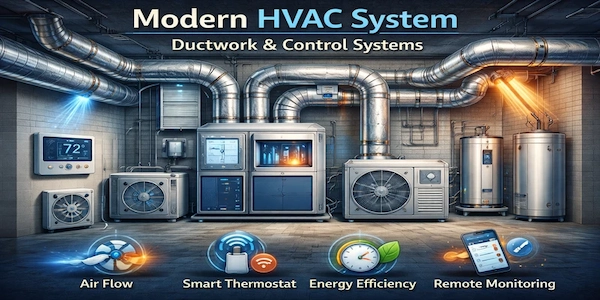
The Kind of Problems HVAC & Building Systems Engineers Spend Their Time Solving
Continuous problems. Variable problems. Constraint-heavy problems. Thermal loads swing with weather, occupancy, time of day. Systems need to respond smoothly without burning excessive energy or requiring weekly service calls. And the answer can't be "just oversize everything": budgets and physical space won't allow it.
You're constantly balancing comfort against efficiency. Meeting strict energy codes while staying within construction budgets. Designing systems that remain serviceable fifteen years after installation when the original installer is long gone and nobody remembers why that damper was positioned there. First cost versus operating cost. Redundancy versus simplicity. Control complexity versus maintenance burden. Pick your tradeoff.
Here's the thing: there's rarely one "correct" answer. You're aiming for robust solutions that perform acceptably across a wide range of conditions, not solutions optimized for one specific scenario that falls apart when reality deviates five percent from your assumptions.
Tools and Skills Used in HVAC & Building Systems
Load calculation software. Airflow and piping models. Energy simulation tools. These support system sizing and performance prediction when used correctly. A model is only as good as the assumptions you feed it, and HVAC models require assumptions about occupancy, equipment schedules, infiltration rates, and a dozen other variables that aren't known precisely at design time.
Equally critical: fluency with codes and standards. ASHRAE guidelines, local building codes, energy regulations: they shape nearly every design decision. You need to understand not just how systems work, but what's actually allowed and required in a given jurisdiction. Code compliance isn't optional, and arguing about it won't change the inspector's mind.
Communication skills matter heavily. You're coordinating with architects who care about ceiling heights and aesthetics, structural engineers who don't want your equipment hanging from their beams, electrical teams whose panels need to fit somewhere, contractors who have to actually install what you designed, and building owners who want to know why it costs so much. Technical correctness doesn't matter if you can't translate constraints into decisions that fit the overall project.
Who HVAC & Building Systems Is a Good Fit For
This suits engineers who enjoy applied physics over theoretical elegance. Do you like working with real operating conditions instead of idealized models? Do you find satisfaction in systems thinking rather than component optimization? If so, HVAC might fit.
It fits people comfortable designing within constraints: codes, budgets, existing structures, coordination with other disciplines. If you value reliability and practicality over novelty, this path makes sense. Patience matters. Attention to detail matters. A small decision about damper placement or control sequence can have significant downstream effects on energy use and occupant comfort five years later.
If you want to see your work directly impact how people experience buildings every single day (whether they notice it or not), HVAC & Building Systems delivers that connection.
Common Misconceptions About HVAC & Building Systems
"HVAC work is just following rules and templates." Except every building is different. Different climate. Different use case. Different constraints. Different budget. Different architect who insists on putting glass curtain walls on the south façade. The codes provide guardrails, but engineering judgment determines whether the system actually works.
Another misconception: HVAC is less technical than other mechanical fields. Look, the math might appear simpler on the surface: basic thermodynamics, fluid mechanics, heat transfer. But the challenge isn't solving isolated equations. It's managing variability and uncertainty over twenty-year lifespans. Predicting loads that depend on occupant behavior. Designing controls that handle scenarios you can't anticipate at design time.
There's also this belief that HVAC is outdated or slow-moving. Meanwhile, energy efficiency mandates keep tightening. Heat pump technology is displacing gas heating. Smart controls and IoT sensors are changing how buildings operate. If you think the field hasn't evolved, you haven't looked at what's being designed today versus ten years ago.
How HVAC & Building Systems Fits Into a Mechanical Engineering Career
Many engineers enter HVAC early because it offers immediate exposure to full-system design and real constraints. You're not just supporting someone else's work: you're owning calculations, layouts, code compliance from day one. Early roles focus on supporting senior engineers, running load calcs, coordinating with other disciplines. With experience, you take ownership of entire building systems or multi-building campuses.
Senior HVAC engineers move into project lead roles, system architecture positions, energy specialist tracks. Others transition into consulting, commissioning (verifying systems actually perform as designed), sustainability roles, or technical leadership within large MEP firms. The path isn't linear: some people stay technical, some shift toward management, some specialize in specific building types like healthcare or data centers.
The skills developed (systems thinking, coordination across disciplines, reasoning about long-term performance) transfer well into management, energy engineering, and infrastructure-focused careers. Companies value people who understand how buildings actually work, not just how they're supposed to work.
Is HVAC & Building Systems Right for You?
If you want to work on complete systems that operate continuously and directly affect how people experience buildings every day, this path fits. If you enjoy balancing technical performance with practical constraints (codes, budgets, coordination, long-term reliability), HVAC aligns naturally with that mindset.
If you prefer narrow optimization problems, short-lived prototypes, or purely analytical work where success is unambiguous, other mechanical paths might feel more satisfying. Neither is better. Just different kinds of problems that appeal to different engineering mindsets.
If you're uncertain whether environmental control and systems-level work match how you think, consider whether you're drawn to understanding how things interact over time or how individual components perform at their limits. Both matter. Choose based on what makes you want to dig deeper into the problem, not just solve it and move on.
Career Outlook & Market Data
Salary Range by Experience
Entry Level (0-2 years)
$58k - $68k annual base
Mid-Level (3-7 years)
$72k - $95k with bonuses
Senior/Lead (8+ years)
$95k - $135k+ (PE license adds $10-15k)
Job Market Growth
8-10% annual growth rate
Above average (US BLS: 8% avg)
~22,000 openings/year
Projected through 2032
Energy efficiency codes driving demand
Work-Life Balance
Good to Very Good (4/5 avg rating)
Typical: 40-45 hours/week
Peak seasons:
50 hours during project deadlines
More predictable than field engineering
Job Security & Demand
Very Stable (4.5/5 rating)
Essential infrastructure in all buildings
Key growth drivers:
• Building electrification mandates
• Energy code updates (IECC, Title 24)
• Aging building stock retrofits
Remote Work Flexibility
Moderate (25% hybrid/remote)
Typical: 2-3 days on-site per week
On-site requirements:
• Site visits for measurements
• Commissioning and testing
Design work increasingly remote-friendly
Career Progression Paths
Technical track (30%)
• Senior Engineer → Principal HVAC
• Building systems specialist
Management track (45%)
• Project Manager → Discipline Lead
• VP of Engineering or Partner
Consulting track (25%)
• Energy consultant or commissioning agent
Top Geographic Markets
Southeast & Sun Belt
Phoenix, Austin, Charlotte, Atlanta
West Coast
San Francisco, Los Angeles, Seattle
Northeast Corridor
NYC, Boston, DC metro
Data sourced from Bureau of Labor Statistics (Mechanical Engineers), Glassdoor (HVAC Engineer), and MEP engineering salary surveys (2025-2026)
What to Expect From HVAC & Building Systems Roles
HVAC engineers work across commercial, institutional, and industrial sectors. Job concentration is highest in urban areas with active construction and major consulting firms.
Top Industries
- • Commercial Buildings - Offices, retail, mixed-use developments (32% of roles)
- • Institutional - Hospitals, universities, government buildings (23% of roles)
- • Industrial Facilities - Warehouses, data centers, manufacturing (18% of roles)
- • Residential - Multi-family housing, high-rise apartments (12% of roles)
- • Energy/Sustainability - Retrofits, LEED, net-zero projects (10% of roles)
- • Mission Critical - Labs, clean rooms, server facilities (5% of roles)
Company Categories
- MEP Consulting Firms - Design consultants for architects/owners
- Engineering-Construction Firms - Design-build, integrated delivery
- Building Owners - In-house engineering teams for portfolios
- HVAC Manufacturers - Trane, Carrier, Daikin application engineers
- Controls Companies - Johnson Controls, Siemens, Honeywell
- Energy Service Companies (ESCOs) - Performance contracting, retrofits
- Commissioning Firms - Third-party verification and testing
Company Size Distribution
38% Mid-size (50-499)
22% Small (10-49)
5% Solo/Startup (<10)
Remote Work Trends
35% Hybrid (2-3 days office)
50% Primarily On-site
Design roles more remote-friendly
Top Geographic Markets
Middle East (UAE, Saudi Arabia)
China (major cities)
Germany & Western Europe
Singapore & SE Asia
Team Structure
Cross-functional: Architects, Electrical
Report to: Lead Engineer or PM
Collaboration-heavy environment
Employment data from LinkedIn (HVAC Engineer), Indeed (HVAC/MEP), and MEP recruiting data (2025-2026)