Fluid Mechanics & CFD: The Flow Verification Layer of Mechanical Engineering
Fluid Mechanics & CFD engineers verify that designs involving flow, heat transfer, and mass transport will perform as intended. They prove assumptions about phenomena that are invisible, continuous, and governed by complex physics. Their work validates behavior that cannot be fully observed or easily measured in physical tests.
What Fluid Mechanics & CFD Engineers Actually Do
CFD engineers prove that invisible physics will behave as intended before anyone builds hardware. They verify flow, heat transfer, and mass transport through computation rather than expensive prototypes. The work centers on phenomena you can't see: pressure fields, velocity gradients, turbulent eddies, thermal boundary layers. These aren't discrete parts you can measure with calipers; they're continuous fields governed by coupled nonlinear equations that make physical testing prohibitively expensive until you've already committed to a design.
Unlike structural engineers who load test discrete components against failure criteria, fluid engineers validate continuous systems where everything interacts with everything else simultaneously. Change one inlet condition and the entire flow field responds; adjust geometry slightly and separation patterns shift unpredictably. Computational Fluid Dynamics turns partial differential equations into numerical predictions, letting engineers verify whether assumptions hold before metal gets cut.
Day-to-day reality involves more judgment calls than software tutorials suggest: choosing turbulence models that might capture the physics you care about, defining boundary conditions for flows you haven't measured yet, interpreting results that look plausible but might be numerically meaningless, validating simulations against sparse experimental data to build confidence that your predictions mean something. Running the software is the easy part. Knowing whether to trust what it tells you separates verification from wishful thinking.
How Fluid Mechanics & CFD Differs From Other Mechanical Roles
The fundamental difference isn't just physics, it's certainty. Structural engineers test a bracket until it breaks, measure the load, compare against requirements, done. Fluid engineers model flows they can't directly observe, using approximations that work until they don't, defending predictions about systems that won't exist for months. When a structural analysis converges, you know the part either meets strength requirements or it doesn't; when a CFD simulation converges, you've proven the numerics are stable, not necessarily that the physics is right.
CFD engineers act as gatekeepers in the design process, answering questions that would otherwise require building expensive hardware: Will this cooling system handle thermal loads? Does flow separate and kill performance? Can we meet aerodynamic targets without redesigning geometry? The work happens in the space between napkin sketches and prototype testing, where computational predictions prevent costly mistakes that physical experiments would catch only after you've invested in tooling.
Computational intensity matters more than most engineers expect. High-fidelity simulations consume days of cluster time, require careful convergence monitoring, and generate terabytes of data that someone needs to interpret intelligently. This isn't clicking "solve" and walking away. It's managing computational resources, debugging divergence, questioning whether that cool-looking vortex structure is real physics or numerical artifact, and knowing when spending another week refining the mesh will actually change the answer versus just burning budget.
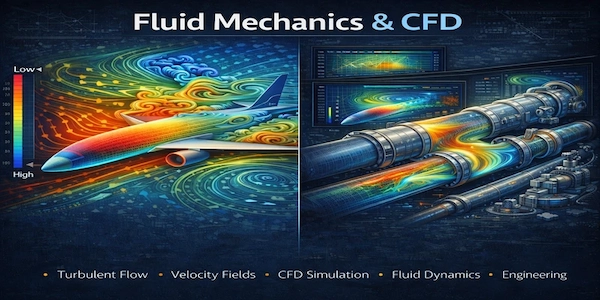
The Kind of Problems Fluid Mechanics & CFD Engineers Spend Their Time Solving
Fluid problems resist clean solutions. Flow separates where you didn't expect it, turbulence develops differently than textbook cases, heat transfer couples with momentum in ways that make simplified models useless, and geometry changes measured in millimeters shift performance by double-digit percentages. Nothing stays linear long enough to trust back-of-envelope calculations, which is precisely why simulation exists: to capture the messy reality before it surprises you in hardware.
Typical challenges: proving an aircraft wing hits L/D targets across the flight envelope without triggering buffet; confirming battery cooling keeps cells below thermal limits during fast charging; demonstrating pressure drop through a heat exchanger won't exceed pump capacity; validating combustor mixing achieves complete reaction before exhaust; diagnosing whether acoustic resonance will develop and destroy components; verifying particle-laden flows won't cause erosion or clog passages. Each question demands understanding which physics matters, which approximations break, and how much uncertainty you're accepting by trusting simulation over testing.
Success in this field rewards comfort with ambiguity. You'll prove performance when boundary conditions are estimates, quantify confidence intervals around predictions, and defend simulation choices to skeptical experimentalists who've seen plenty of beautiful CFD results that collapsed under real-world conditions. Unlike structural pass/fail metrics, fluid verification often negotiates acceptable tradeoffs: gaining efficiency while staying within pressure drop budgets, optimizing mixing without exceeding residence time limits, pushing performance near stability boundaries without crossing into failure regimes.
Tools and Skills Used in Fluid Mechanics & CFD Engineering
Commercial CFD packages (ANSYS Fluent, STAR-CCM+, COMSOL, OpenFOAM alongside specialized codes for combustion, multiphase, or reacting flows) provide the infrastructure, but they're not the skill. Meshing tools like ICEM, Pointwise, or snappyHexMesh matter more than most engineers expect; poor meshes produce plausible-looking results that prove nothing, and recognizing mesh-induced errors requires understanding how discretization schemes interact with flow physics.
The real differentiator is physics intuition married to numerical methods knowledge: knowing when k-epsilon turbulence models fail spectacularly, understanding how boundary layer resolution affects heat transfer predictions, recognizing when flow instabilities are real versus numerical artifacts, predicting where simulations will struggle before spending weeks running them. Software tutorials teach menu navigation; experience teaches judgment about what those menus actually do to your equations.
Programming increasingly separates competent CFD engineers from excellent ones. Python for automation and post-processing, MATLAB for analysis workflows, Fortran for solver customization when commercial codes don't handle your physics. High-performance computing literacy helps too; knowing how to scale simulations across clusters efficiently, debug parallel communication bottlenecks, and manage storage when your flow field outputs hit terabyte scale matters more as problems grow complex.
Who Fluid Mechanics & CFD Is a Good Fit For
This path suits engineers who get satisfaction from proving invisible physics computationally rather than building tangible hardware. If you're drawn to questions about transport phenomena (how momentum, energy, and mass move through systems you can't directly observe) and find validation in numerical rigor rather than physical prototypes, the work aligns naturally with that thinking style.
It demands patience that some engineers lack: simulations run for days, convergence behavior surprises you, validation campaigns take months, and proving your model is trustworthy requires defending methodology to skeptics who've seen beautiful CFD visualizations that bore no relationship to reality. You'll balance computational expense against confidence requirements constantly, knowing when a quick RANS model suffices versus when you need LES or DNS resolution to capture physics that actually matters.
The match strengthens if you're comfortable operating in uncertainty: making defensible approximations with incomplete information, quantifying confidence in predictions, and signing off on simulations knowing they're wrong in ways you've hopefully bounded. If proving complex flow behavior through computation appeals more than building test rigs or designing hardware, and you're willing to defend those computational predictions rigorously before anyone commits to manufacturing, this specialization offers intellectually demanding work with real consequence.
Common Misconceptions About Fluid Mechanics & CFD
The most dangerous misconception: CFD is just running commercial software. Click setup, hit solve, export pretty pictures, done. Except poor modeling choices produce plausible-looking results that are completely wrong (smooth velocity fields, converged residuals, professional-grade visualizations that predict performance nowhere near reality). What separates trustworthy verification from expensive fiction is understanding the physics, numerics, and limitations well enough to know when your simulation is lying to you before hardware proves it wrong.
Another myth: CFD replaces testing. It doesn't and won't. CFD lets you verify designs computationally before committing to hardware, reducing prototype iterations and catching problems early when changes are cheap. But simulation itself requires validation. You verify the design with CFD, then validate your CFD against experimental data to prove the model is trustworthy. Engineers who skip validation learn this lesson expensively when predictions collapse under real-world conditions.
Finally, some assume fluid engineers only work aerospace. While aerospace employs many CFD specialists, flow verification applies wherever transport phenomena matter: HVAC systems moving air through buildings, automotive cooling managing thermal loads, turbomachinery optimizing efficiency, chemical reactors mixing species, biomedical devices modeling blood flow, energy systems balancing heat transfer. If fluid motion, thermal transport, or species mixing affects performance, someone's running CFD to predict it.
How Fluid Mechanics & CFD Fits Into a Mechanical Engineering Career
Most CFD engineers enter through graduate work in fluid mechanics, aerospace engineering, or applied physics. The field rewards deep physics understanding that undergraduate curricula rarely provide. Early roles involve running simulations under supervision, learning solver behavior, debugging convergence failures, and developing intuition for what results should look like before the computer produces them. You're not trusted to verify critical designs immediately; you're building the judgment that makes verification credible.
Experience shifts responsibility from executing analyses to owning modeling strategy: choosing turbulence models, defining validation campaigns, customizing solvers when commercial codes don't handle your physics, defending methodology to program reviews. Senior engineers become technical authorities: the person design teams consult when flow questions arise, who guides decisions about whether CFD predictions are trustworthy enough to proceed, who develops modeling capabilities that give their organization competitive advantage.
The skill set transfers well beyond running simulations. Research organizations value engineers who understand both physics and computation deeply; advanced development programs need people who can predict performance in unexplored regimes; technical leadership roles reward the ability to assess risk in complex systems where testing is incomplete. If you build expertise in computational verification of transport phenomena, opportunities follow in directions that leverage rigorous technical thinking over narrow software specialization.
Is Fluid Mechanics & CFD Right for You?
CFD isn't about building hardware, touching prototypes, or seeing your work take physical form quickly. It's computational verification: proving invisible physics numerically, acting as technical gatekeeper before designs become metal, defending predictions to skeptics who trust experiments more than equations. If that resonates, if you'd rather spend weeks refining turbulence models than iterating physical prototypes, if validation through rigorous simulation appeals more than hands-on testing, the work offers sustained technical depth that few specializations match.
If you need tangible outputs, prefer fast iteration cycles, or want direct connection to physical systems you can measure and observe, design engineering or experimental roles will feel more natural. Neither path is superior; they reward different thinking styles, and mismatching your preferences to the work guarantees frustration regardless of technical capability.
Still uncertain whether computational verification fits how you think? A structured assessment might clarify whether proving flow behavior through simulation aligns with your judgment style better than alternative mechanical engineering paths that emphasize different skills.
Career Outlook & Market Data
Salary Range by Experience
Entry Level (0-2 years)
$68k - $82k annual base
Mid-Level (3-7 years)
$85k - $115k with bonuses
Senior/Lead (8+ years)
$115k - $155k+ (PhD adds $10-18k)
Job Market Growth
9-12% annual growth rate
Above average (simulation adoption growing)
~8,500 openings/year
Projected through 2032
Aerospace, automotive, energy driving demand
Work-Life Balance
Good (4.0/5 avg rating)
Typical: 40-48 hours/week
Peak seasons:
50-55 hours during project deadlines
Long simulation runs can extend work hours
Job Security & Demand
Very Stable (4.4/5 rating)
High-value specialty role
Key growth drivers:
• Electric vehicle thermal management
• Renewable energy turbomachinery
• Aerodynamic efficiency optimization
Remote Work Flexibility
High (55% hybrid/remote)
Typical: 1-2 days on-site per week
On-site requirements:
• Experimental validation testing
• Collaboration with design teams
Computational work highly portable
Career Progression Paths
Technical track (55%)
• CFD Engineer → Principal Analyst
• Fluids specialist or researcher
Management track (30%)
• Engineering Manager → Director
• Chief Engineer or Technical Fellow
Academia track (15%)
• PhD → Professor or research scientist
Salary and job growth data sourced from Glassdoor CFD Engineer Salaries, Glassdoor Fluids Engineer Salaries, and aerospace/automotive/energy industry compensation surveys for flow simulation specialists (2025-2026)
What to Expect From Fluid Mechanics & CFD Roles
Fluid mechanics & CFD engineers work across aerospace, automotive, energy, and advanced manufacturing, anywhere flow, heat transfer, or turbomachinery performance matters.
Top Industries
- Aerospace & Defense - Aerodynamics, propulsion, thermal systems (32% of roles)
- Automotive - Cooling, aerodynamics, underhood airflow (24% of roles)
- Energy & Power - Turbines, combustion, heat exchangers (18% of roles)
- HVAC & Building Systems - Ventilation, climate control (10% of roles)
- Chemical Processing - Reactors, mixing, separation processes (8% of roles)
- Biomedical Devices - Blood flow, drug delivery, respiratory devices (5% of roles)
Company Categories
- OEMs - Aerospace, automotive, turbomachinery manufacturers
- Engineering Consulting - Specialized CFD services and analysis
- Software Companies - ANSYS, Siemens, Dassault, CD-adapco
- National Labs - DOE, NASA, Sandia, NREL research facilities
- Universities - Academic research and advanced method development
- Startups - Electric aviation, hydrogen systems, advanced propulsion
- Defense Contractors - Weapons systems, hypersonics, propulsion
Company Size Distribution
29% Mid-size (100-999)
18% Small (10-99)
5% Startup (<10)
Top Geographic Markets
Germany (automotive, turbomachinery)
United Kingdom (aerospace, F1)
France (aerospace, energy)
Japan (automotive, electronics cooling)
Remote Work Trends
45% Hybrid (2-3 days remote)
30% Primarily On-site
Computational work enables flexibility
Team Structure
Cross-functional: Design, Testing, Propulsion
Report to: Chief Engineer or Technical Lead
Often embedded in product teams
Employment data from LinkedIn (CFD Engineer), Indeed (Fluid Dynamics), and aerospace/automotive recruiting data (2025-2026)