What Does Design & Product Development Mean in Mechanical Engineering?
Design & Product Development is where mechanical engineers transform ideas into real, manufacturable products. It's the bridge between early ideas and manufacturable products, requiring engineers to make technical decisions long before all information is available.
What Design & Product Development Engineers Actually Do
You start with half-formed ideas, conflicting stakeholder requests, and no spec sheet. Your job is to turn that ambiguity into something real, a product that can be built, shipped, and supported long after you've moved on to the next project. Work begins before anyone knows what "done" looks like.
This means translating vague needs into concrete requirements, sketching concepts until one stops being terrible, and iterating CAD models while making early calls on geometry, materials, and interfaces. Often before you have load data. Often before anyone's tested the use case. You're making decisions that matter, without the luxury of certainty.
The job is fundamentally about tradeoffs under pressure. Performance versus cost. Strength versus weight. Innovation versus schedule risk. Every choice you make upstream cascades into everything that follows, manufacturing, testing, service life. Early mistakes are expensive. Early wins compound.
How Design & Product Development Differs From Other Mechanical Roles
This is a creation role, not a validation one. You're not proving something works. You're defining what "it" is in the first place.
Analysis engineers verify designs against known loads. You decide what those loads should be. Manufacturing engineers optimize production of an existing part. You determine what that part looks like before it reaches the factory. Managers coordinate teams around execution. You're still wrist-deep in technical decisions, choosing materials and tolerances while other roles focus on orchestration.
What sets design apart is ownership of ambiguity. Requirements shift. Constraints evolve. The "right answer" doesn't exist yet because you're the one defining the question. If that sounds uncomfortable, this role isn't the fit. If it sounds like leverage, keep reading.
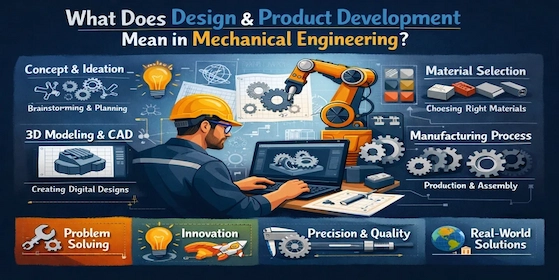
The Kind of Problems Design Engineers Spend Their Time Solving
Forget clean problem statements with obvious solutions. You're dealing with contradictory requirements, incomplete data, and stakeholders who want everything faster, lighter, cheaper, and stronger at the same time.
Strength costs weight. Performance costs money. Innovation carries risk. You're constantly choosing which constraint to violate least, making calls before all the data arrives. Designs don't progress linearly from concept to final. They spiral inward through iteration, getting less wrong with each cycle.
This rewards engineers who can work with imperfect information and aren't paralyzed by changing requirements. Success isn't measured by finding the optimal solution. It's measured by converging on something that works well enough, can actually be built, and ships before the market moves on.
Tools and Skills Used in Design & Product Development
CAD skills for engineers are foundational—but CAD isn't just a documentation tool. It's how you think. Models capture intent, communicate decisions, and evolve as understanding deepens. If you can't model it cleanly, you probably don't understand the problem yet. Proficiency in SolidWorks, CREO, NX, or similar parametric modeling tools is expected, not optional.
Analysis supports design choices but doesn't drive them. You'll run quick calculations, simplified sims, and lean on rules of thumb to screen bad ideas fast. Deep FEA studies and exhaustive validation? That comes later, often handled by specialists. Your job is identifying risk early, not proving everything to five decimal places.
Just as critical: prototyping and talking to humans. You're constantly translating between manufacturing's constraints, supply chain's lead times, and testing's validation needs. Abstract concepts don't survive contact with reality. Prototypes force honesty. Cross-functional communication keeps you from designing elegant solutions that can't actually be built.
Who Design & Product Development Is a Good Fit For
This works if uncertainty doesn't paralyze you. Waiting for complete information means never starting. You'd rather iterate toward an answer than stall waiting for perfect clarity.
You see systems, not just parts. Optimizing one variable at the expense of everything else feels wrong. Every decision carries tradeoffs, and you're more interested in finding the best compromise than proving the theoretical ideal. Perfect solutions don't exist. Good-enough solutions that ship on time do.
If turning abstract concepts into physical reality gives you energy, even when it means revisiting yesterday's "final" decision, this path probably fits. If changing requirements feel like failure instead of normal iteration, look elsewhere.
Common Misconceptions About Design & Product Development
"It's just CAD work." No. CAD is the output, not the job. The work is deciding what to model, why it needs that geometry, and how it'll survive contact with manufacturing, shipping, and years of field use. The 3D model is just how you document those decisions.
"Design engineers don't need deep technical knowledge." Also wrong. Weak fundamentals in mechanics, materials, and physics lead to expensive mistakes baked into early decisions. Fixing bad geometry after tooling is cut costs orders of magnitude more than getting it right when the design was still flexible. Judgment matters. Judgment requires knowledge.
"Good design is creative and free-flowing." Partly true, mostly not. Creativity exists, but it's creativity within brutal constraints, manufacturing processes, cost targets, material properties, regulatory requirements. Unconstrained creativity produces art. Constrained creativity produces products that ship.
How Design & Product Development Fits Into a Mechanical Engineering Career
Design is a common entry point for mechanical design engineers because it sits at the center of how products get made. Early on, you're executing, modeling parts, running revisions, learning how your geometry choices create headaches (or savings) in manufacturing, assembly, and service.
Experience brings ownership. Instead of modeling someone else's concept, you're driving subsystem architecture, leading early-stage development, coordinating with other disciplines. Senior design engineers often move into technical leadership, systems engineering, or management. The design engineer career path offers flexibility—you can specialize deeper in technical areas or transition into leadership roles where early exposure to tradeoffs and cross-functional problem-solving becomes the primary skill, not a side task.
The skills transfer unusually well. Design teaches you how products fail, how early decisions cascade through production, and where small changes create outsize leverage. That intuition is valuable in manufacturing optimization, quality investigation, and leadership. It matters anywhere understanding the whole system beats optimizing one isolated piece.
Is Design & Product Development Right for You?
This isn't about prestige or unlocking creativity. It's about whether you can function in ambiguity. Open-ended problems. Incomplete data. Making decisions that matter before you have all the answers. If that sounds energizing, investigate further.
If you prefer well-defined problems with stable requirements, where validation matters more than exploration, other specializations will feel more natural. Neither path is superior. Fit matters. Choose based on how you think, not what sounds impressive on a business card.
Career Outlook & Market Data
Salary Range by Experience
Entry Level (0-2 years)
$68k - $78k annual base
Mid-Level (3-7 years)
$82k - $108k with bonuses
Senior/Lead (8+ years)
$110k - $160k+ total comp
Job Market Growth
7-11% annual growth rate
Above average (US BLS: 6% avg)
~45,000 openings/year
Projected through 2032
Consumer products & EV growth driving demand
Work-Life Balance
Good (3.8/5 avg rating)
Typical: 40-45 hours/week
Peak seasons:
45-55 hours during product launches
Project deadlines require schedule flexibility
Job Security & Demand
Stable (4.1/5 rating)
Core function across industries
Key growth drivers:
• Product innovation acceleration
• Sustainability & eco-design trends
• Less automation risk vs pure drafting
Remote Work Flexibility
Hybrid common (15% fully remote)
Typical: 2-3 days on-site per week
On-site requirements:
• Prototype builds & testing
• Cross-functional collaboration
CAD/modeling work can be remote
Career Progression Paths
Technical track (50%)
• Senior Designer → Lead/Principal
• Chief Engineer or Systems role
Management track (50%)
• Team Lead → Engineering Manager
• Director of Product Development
Data sourced from Bureau of Labor Statistics (Product Design), Glassdoor (Product Design), and product development salary surveys (2025-2026)
What to Expect From Design & Product Development Roles
Product design engineer jobs and mechanical design engineer positions span diverse industries, from early-stage startups to Fortune 500 companies. Design engineering jobs are concentrated in major tech hubs, manufacturing centers, and R&D corridors where prototyping and iteration infrastructure exists.
Top Industries
- Consumer Electronics - Apple, Samsung, Dyson (28% of roles)
- Automotive & Transportation - Tesla, Ford, Rivian (22% of roles)
- Medical Devices - Medtronic, Boston Scientific (15% of roles)
- Aerospace & Defense - Boeing, SpaceX, Lockheed (12% of roles)
- Industrial Equipment - GE, Caterpillar, 3M (11% of roles)
- Consumer Products - Nike, P&G, IKEA (8% of roles)
- Energy & Cleantech - Tesla Energy, Vestas (4% of roles)
Company Categories
- Large Corporations - 10,000+ employees, structured teams
- Mid-Size Companies - 500-10,000 employees, diverse projects
- Design Consultancies - IDEO, Frog, specialized expertise
- Tech Startups - 10-500 employees, rapid iteration
- R&D Departments - Corporate labs, university partnerships
- Contract Manufacturers - Foxconn, Flextronics, global scale
- Government/Defense - NASA, DOD contractors, long-term projects
Company Size Distribution
28% Mid-size (100-999)
23% Small (10-99)
14% Startup (<10)
Top Geographic Markets
Germany (industrial design)
China (consumer products)
Japan (electronics, automotive)
United Kingdom (medical, aerospace)
Remote Work Trends
58% Hybrid (2-3 days office)
30% Primarily On-site
Hardware development requires lab access
Team Structure
Cross-functional: Marketing, Manufacturing
Report to: Engineering Manager or Director
Matrix structure common in large orgs
Employment data from LinkedIn (Product Development), Indeed (Product Design), and design engineering recruiting data (2025-2026)