Automotive & Transportation Engineering: Integrating Mechanical Systems at Scale
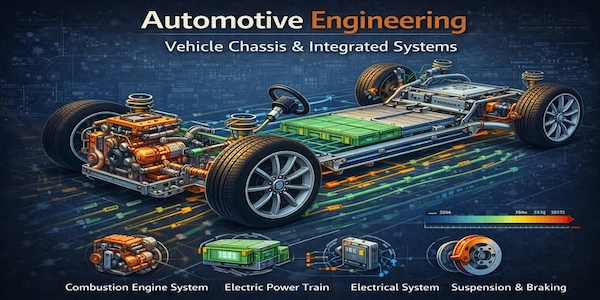
Automotive & Transportation engineers integrate many mechanical subsystems into functioning vehicles and transportation platforms. Unlike roles focused on individual components, this specialization operates at the system level, where structure, motion, power, thermal behavior, safety, and manufacturability must work together under real-world constraints.
What Automotive & Transportation Engineers Actually Do
Picture an engineer looking at a vehicle design where the battery cooling system takes up space needed for the suspension components, the extra structural steel adds 40kg that pushes the vehicle over its weight target, and the manufacturing team just said the parts can't be assembled in the order you planned on the factory floor. That's automotive engineering. It's not about making one perfect part. It's about figuring out how engines, transmissions, suspensions, brakes, the vehicle frame, cooling systems, and computer controls can all fit in the same vehicle and work together without breaking each other.
The work is fundamentally about solving puzzles where every piece affects every other piece. You make the suspension stiffer to improve cornering, and suddenly the noise and vibration team is dealing with more road noise coming into the cabin. You change how the engine mounts to the frame to reduce vibrations, and it accidentally creates stress on a mounting bracket that nobody noticed until you built a physical prototype. Automotive engineers spend less time doing calculations than you might expect and far more time coordinating between different teams, writing down how components connect to each other, and explaining why changing one thing means six other teams need to adjust their designs.
How Automotive & Transportation Engineering Differs From Other Mechanical Roles
While a design engineer might spend three weeks optimizing a bracket to shave off 50 grams, an automotive engineer is deciding whether that bracket interface even makes sense given what's happening two subsystems over, whether the mass savings matter when the bumper beam already blew the target by 2kg, and whether this whole assembly approach creates a warranty risk nobody's quantified yet. The scope is just different. You're not chasing perfection in a component; you're trying to make several imperfect systems coexist without the vehicle falling apart at 100,000 miles.
What makes this different from other mechanical work is the density of constraints that all matter simultaneously: cost, mass, packaging, safety, durability, compliance, manufacturability, serviceability. None of them are suggestions. Miss a crash standard by 2%, and the vehicle doesn't launch. Exceed the cost target by $50 per unit on a platform with 200,000 annual volume, and you just lost $10M that has to come from somewhere else.
The Kind of Problems Automotive Engineers Spend Their Time Solving
Here's a problem that lands on your desk Tuesday morning: the ride comfort target says the suspension needs softer bushings to isolate road harshness, but the handling dynamics team flagged that the current setup has too much compliance during aggressive cornering, durability models show those bushings will degrade 30% faster in northern climates where salt accelerates wear, and the proposed bushing compound costs $4 more per corner with only one qualified vendor. You have until Friday to recommend a direction because prototypes start builds in three weeks. No clean answer exists, just tradeoffs you have to document and defend.
Or consider thermal management in an electric vehicle where the battery needs active cooling to maintain cycle life, cabin heating cuts into winter range, the motor generates heat spikes under sustained load, and power electronics have strict temperature limits. The physics works on paper until you realize the heat exchanger location creates an aerodynamic drag penalty the aero team refuses to accept, so now you're redesigning the entire cooling architecture because a 0.02 Cd increase matters at highway speed.
What makes these problems hard isn't the individual engineering. It's that the solution space keeps collapsing as constraints pile up, you're making decisions with incomplete data because testing hasn't happened yet, and the operating environment spans Arizona summer heat to Minnesota winter cold to aggressive drivers who will exceed every duty cycle assumption you made.
Tools and Skills Used in Automotive & Transportation Engineering
The software stack is less exotic than you might expect. CAD for managing assemblies and checking packaging fits, MATLAB or similar for quick dynamics checks, spreadsheets for tracking requirements and interface definitions, and whatever your company uses for PDM since you'll spend substantial time making sure the electrical team's connector locations don't conflict with your structural hard points. You'll encounter simulation tools for vehicle dynamics, thermal systems, and durability prediction, but often at coarser fidelity than component-level FEA because you're trying to understand system behavior under realistic load cases. The analysis work tends to be broader and faster rather than deeper and slower.
What matters more than tool proficiency is the ability to coordinate across disciplines without losing track of what you're actually trying to solve. You're defining interfaces between mechanical, electrical, and software systems. You're negotiating with manufacturing about what's actually buildable at volume. You're making sure safety and compliance understand what assumptions your architecture depends on. That means reading wiring diagrams well enough to spot interference issues, understanding controls well enough to know when a mechanical solution is fighting the software, and recognizing when a manufacturability problem is actually a design problem in disguise.
Who Automotive & Transportation Engineering Is a Good Fit For
If you get more satisfaction from figuring out how ten imperfect subsystems can work together than from perfecting one component to theoretical limits, this might be your path. The work suits people who enjoy seeing the whole machine rather than just their corner of it, who can hold multiple conflicting constraints in their head simultaneously without getting paralyzed, and who don't mind that "good enough across all conditions" often beats "optimal in one scenario." Comfort with ambiguity and incomplete information is essential. You rarely have all the data you want when the decision is due.
Red flags: if you need deep focus on a single technical problem for weeks at a time, automotive is the wrong choice. The work is inherently interruptive and multi-threaded. If you hate compromise and want every technical decision to be "right" rather than "defensible given constraints," you'll be frustrated constantly. If you prefer hands-on building over coordination and documentation, there are better mechanical specializations. But if you like owning outcomes at the platform level and making decisions that shape entire vehicles rather than individual parts, this aligns well with that mindset.
Common Misconceptions About Automotive & Transportation Engineering
The biggest misconception is that automotive engineers spend their time sketching concept vehicles or making clay models in a design studio, which is what industrial designers do, not mechanical engineers. Actual automotive engineering is decidedly unglamorous. You're writing interface control documents, attending design reviews where you explain why the battery cooling system can't route through the location the packaging team allocated because it conflicts with crash structure load paths, running trade studies on whether aluminum or high-strength steel makes more sense given cost-mass-durability tradeoffs, and validating that the thermal management strategy doesn't create warranty problems in extreme climates.
Another persistent myth is that automotive is a legacy field stuck in internal combustion engines and old-school mechanical thinking, which would be hilarious to anyone currently dealing with battery thermal runaway mitigation strategies, software-defined vehicle architectures, or the integration challenges of packing power electronics and high-voltage battery systems into vehicles that still need to meet crash standards designed around fuel tanks and engine blocks. Modern automotive engineering is as much about electrification and controls integration as it is about traditional powertrain or chassis work.
How Automotive & Transportation Engineering Fits Into a Mechanical Engineering Career
Most people start in subsystem roles: chassis engineer responsible for suspension mounting interfaces, thermal engineer managing cooling system integration, or powertrain engineer dealing with vibration isolation and mounting strategies. You learn one piece of the system deeply enough to understand how it connects to everything else. That phase typically lasts two to four years. The career inflection point comes when you stop being "the suspension person" and start being the engineer who can take ownership of how suspension, structure, powertrain, and thermal systems coexist in a platform architecture that actually works.
From there, paths diverge. Technical track tends toward chief engineer roles or systems architecture positions where you define vehicle-level integration strategies and serve as the technical authority when conflicts arise between subsystems. Management track leans toward engineering managers who run teams, program managers who own schedules and budgets, and eventually director-level roles accountable for entire product lines. Both tracks value the same skill: understanding how decisions propagate across complex systems.
Is Automotive & Transportation Engineering Right for You?
If the idea of defining how a battery pack, electric drivetrain, thermal system, crash structure, and interior packaging coexist in the same vehicle architecture sounds more interesting than optimizing a single bracket modal response, automotive engineering might align with how you think. The work is fundamentally about integration under constraints that all matter simultaneously. You're not perfecting components in isolation; you're figuring out how imperfect subsystems designed by different teams can function together well enough to meet performance targets, pass regulations, survive durability testing, and not bankrupt the program on cost or mass.
This isn't the right path if you need long periods of uninterrupted technical work, want every decision to have a clear "correct" answer, or prefer problems with well-defined boundaries. Automotive is inherently messy. Requirements shift, constraints conflict, testing reveals problems nobody predicted, and you're making calls with incomplete data because the prototype build can't wait for perfect information. Some engineers thrive in that environment; others find it exhausting. Neither response is wrong, but alignment matters more than credentials.
Career Outlook & Market Data
Salary Range by Experience
Entry Level (0-2 years)
$70k - $85k annual base
Mid-Level (3-7 years)
$88k - $118k with bonuses
Senior/Lead (8+ years)
$118k - $160k+ (EV experience adds $12-20k)
Job Market Growth
8-15% annual growth rate
Strong growth (EV transformation driving demand)
~12,000 openings/year
Projected through 2032
EV, autonomy, and electrification fueling growth
Work-Life Balance
Moderate (3.5/5 avg rating)
Typical: 45-50 hours/week
Peak seasons:
55-60 hours during launch cycles
Production deadlines drive overtime
Job Security & Demand
Very Stable (4.2/5 rating)
Essential industry role
Key growth drivers:
• Electric vehicle platforms
• Autonomous vehicle integration
• Battery thermal management systems
Remote Work Flexibility
Moderate (35% hybrid/remote)
Typical: 3-4 days on-site per week
On-site requirements:
• Prototype testing and validation
• Cross-functional integration work
Hardware focus requires on-site presence
Career Progression Paths
Technical track (45%)
• Automotive Engineer → Principal Engineer
• Systems architect or technical fellow
Management track (45%)
• Engineering Manager → Director
• Program manager or VP Engineering
Entrepreneurial track (10%)
• Automotive startups or EV companies
Salary and job growth data sourced from Glassdoor Automotive Engineer Salaries, U.S. Bureau of Labor Statistics, and automotive industry compensation surveys (2025-2026)
What to Expect From Automotive & Transportation Engineering Roles
Automotive & transportation engineers work across OEMs, suppliers, EV startups, and mobility platforms, anywhere complex mechanical systems must integrate at scale.
Top Industries
- Traditional Automotive OEMs - Platform engineering, powertrains, chassis (42% of roles)
- Electric Vehicle Startups - EV architecture, battery integration, thermal systems (28% of roles)
- Automotive Suppliers - Tier 1/2 suppliers for subsystems (18% of roles)
- Heavy-Duty & Commercial Vehicles - Trucks, buses, construction equipment (6% of roles)
- Autonomous Vehicle Companies - Integration of sensors, controls, safety systems (4% of roles)
- Rail & Mass Transit - Trains, metro systems, light rail (2% of roles)
Company Categories
- OEMs - Ford, GM, Toyota, VW, Honda, BMW, Mercedes
- EV Companies - Tesla, Rivian, Lucid, Polestar, BYD
- Tier 1 Suppliers - Bosch, Continental, Denso, ZF, Magna
- Heavy Equipment - Caterpillar, John Deere, Volvo, Paccar
- Autonomous/Tech - Waymo, Cruise, Aurora, Argo AI
- Mobility Platforms - Uber, Lyft, Bird, Lime
- Consulting - AVL, Ricardo, FEV, Roush
Company Size Distribution
28% Mid-size (100-999)
15% Startups (10-99)
5% Consulting
Top Geographic Markets
Germany (Stuttgart, Munich, Wolfsburg)
China (Shanghai, Shenzhen, Beijing)
Japan (Tokyo, Nagoya, Yokohama)
South Korea (Seoul, Ulsan)
Remote Work Trends
25% Hybrid (2-3 days remote)
65% Primarily On-site
Hardware testing requires on-site presence
Team Structure
Cross-functional: Electrical, Controls, Manufacturing
Report to: Chief Engineer or Program Manager
Matrix organization structure common
Industry and employment data from LinkedIn Talent Insights: Automotive Engineer roles, Indeed Job Market Analysis: Automotive Engineer, and automotive industry recruiting data (2025-2026)