Aerospace & Marine Engineering: Designing for Extreme Operating Environments
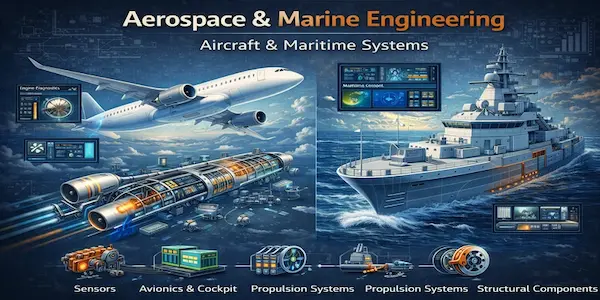
Aerospace and marine engineers design mechanical systems that must operate reliably in environments where failure is not tolerated: high altitude, vacuum, extreme pressure, corrosive saltwater, large temperature gradients, sustained vibration, and long service lives with limited maintenance access.
What Aerospace & Marine Engineers Actually Do
You're designing a bracket for a satellite in geosynchronous orbit. It weighs 47 grams. If it fails, the satellite loses attitude control and becomes $300 million of drifting metal. The bracket will experience launch vibration, thermal cycles from -180°C to +120°C every 90 minutes, micro-meteorite impacts, and must function for fifteen years without maintenance. This is Tuesday.
Aerospace and marine engineers build mechanical systems for environments that actively try to destroy them: vacuum, saltwater corrosion, sustained vibration, extreme pressure differentials, temperature swings that would crack most materials. Failure isn't just expensive—it's often catastrophic and sometimes fatal.
The work splits into two modes. First: defining what "extreme" actually means for your specific system. A turbine blade sees different stresses than a submarine hull, which faces different challenges than a mars rover wheel. You're translating vague environmental descriptions into precise load cases: launch g-forces, wave impacts at specific sea states, thermal gradients across structural joints, fatigue cycles over decades.
Second: proving your design survives those conditions. Not through optimism or experience, but through analysis, testing, and documentation that can be reviewed by certification authorities who assume you're wrong until proven otherwise. Edge cases aren't rare—they're built into the baseline. You're designing for the worst Tuesday, not the best one.
How Aerospace & Marine Engineering Differs From Other Mechanical Roles
Most mechanical engineers can add material if they're uncertain. Aerospace and marine engineers cannot. Every gram matters. Every weld point is scrutinized. Every assumption is documented and must survive peer review by people whose job is to find your mistakes.
The difference isn't just rigor—it's traceability. Five years after you design a component, someone will ask why you chose that bolt torque specification. You need an answer that references a calculation, which references a load case, which references a requirement, which references a standard. If any link in that chain is missing or wrong, the entire assembly gets re-certified. This isn't bureaucracy—it's how you prove to regulators that a structure won't fail at 35,000 feet or 300 meters below sea level.
Compare this to consumer product design, where iteration is cheap and field failures mean warranty claims. Or manufacturing engineering, where the question is "how do we build a thousand of these?" instead of "will this work after 50,000 thermal cycles in vacuum?" Or pure analysis roles, where you model systems but don't own the decision when your model disagrees with a test result at 2 AM before a launch window.
Here's what really separates it: you're designing for conditions you've never personally experienced and cannot easily replicate. You trust your models because you've validated them against edge cases, not because they match your intuition.
The Kind of Problems Aerospace & Marine Engineers Spend Their Time Solving
A propulsion mount is vibrating at 847 Hz during ground testing. The frequency wasn't predicted by your finite element model. It's not in the requirement specifications. But it's there, and it's coupling with a thermal expansion mode you didn't think mattered. Launch is in six weeks. This is the kind of problem that doesn't fit into neat categories.
Most challenges are multi-physics puzzles where changing one variable cascades through the system. Fix a thermal expansion problem by switching materials, and suddenly you've changed the galvanic corrosion risk, the fatigue properties, and the attachment method—each requiring re-analysis. Prevent buckling in a lightweight structure, and you've added stiffeners that change the vibration modes, which affects the loads, which might require thicker skin, which violates weight budgets.
Then there's the time dimension. Failures here don't happen immediately—they develop over months or years. A crack initiates at cycle 8,426 and propagates slowly until cycle 31,903 when catastrophic failure occurs. Your job is to predict this before building the hardware, or better yet, design so it never starts.
The questions you're actually answering: Will this joint last 40,000 flight hours? What happens when a hydraulic line loses pressure at altitude while the structure is cold-soaked? Can we operate with one pump failed? Show your work. Bring data. Be conservative, but not so conservative the aircraft can't take off.
Tools and Skills Used in Aerospace & Marine Engineering
You'll spend more time in ANSYS, Nastran, or Abaqus than you will in CAD. The geometry already exists—your job is proving it won't fail. FEA meshes with 2 million elements. Fatigue crack propagation models. Thermal simulations that take 14 hours to run. CFD analysis of flow separation around control surfaces. These aren't tools for optimization—they're tools for verification.
But software skill is table stakes. What separates competent engineers from trusted ones is fluency in the regulatory language: FAA Part 25, MIL-STD-1540, ASME Section VIII, DNV-GL rules. These documents don't just set requirements—they define how you think about safety margins, failure tolerance, and acceptable risk. You're not just building systems; you're building systems that satisfy regulators who've seen every clever shortcut that didn't work.
Then there's the skill no university teaches directly: technical writing under scrutiny. Every design decision gets documented in reports read by stress analysts, certification engineers, quality auditors, and sometimes accident investigators. You're explaining your assumptions, showing your margins, and justifying why this particular approach is both necessary and sufficient. Vague language fails reviews. Missing traceability fails audits.
The hardest skill? Knowing when your model is lying to you. Simulation says the part is fine, but the test article cracked. Do you trust the test or debug the model? The answer determines whether you're an analyst or an engineer.
Who Aerospace & Marine Engineering Is a Good Fit For
Do you read failure investigation reports for fun? When something breaks, is your first thought "I wonder what the load case was"? Do you instinctively distrust round numbers and feel uneasy when someone says "it should be fine"? This might be your field.
The work attracts engineers who think in safety factors and confidence intervals rather than best guesses. People who would rather spend three days verifying a calculation than risk being wrong. Who understand that "probably works" is not an acceptable engineering conclusion when lives depend on your signature.
It's not for everyone. If you thrive on rapid prototyping, iteration, and seeing immediate results, this will feel constraining. If you prefer creative exploration over methodical verification, the documentation requirements will frustrate you. If you like moving fast and breaking things, this is the wrong room—here, we move carefully and prevent things from breaking.
But if you've ever stayed up late worrying about a failure mode nobody else considered, if you find satisfaction in proving a design is robust rather than just functional, if you want your work to still be operating correctly decades from now—this specialization offers that kind of engineering.
Common Misconceptions About Aerospace & Marine Engineering
Misconception #1: "It's all cutting-edge innovation."
Reality: Most aerospace and marine engineering is deliberately conservative. You're using materials and methods that have decades of service history because novelty introduces risk. The International Space Station uses flight computers less powerful than your phone—not because NASA can't afford better, but because those systems have heritage and proven reliability. Innovation happens, but it's measured in millimeters per year, not disruptive leaps.
Misconception #2: "You're either in the lab or running simulations all day."
Wrong. You're in meetings. Lots of them. Design reviews where structural engineers argue with thermal engineers about attachment methods. Certification meetings where you're defending your analysis approach to auditors. Coordination meetings where you're explaining why a seemingly minor change requires re-analysis of six other subsystems. Analysis is maybe 30% of the job. The rest is communication, documentation, and verification.
Misconception #3: "You need an aerospace degree from MIT or Caltech."
Not really. Many successful aerospace engineers have mechanical engineering degrees from state schools. Security clearances matter more than prestige for defense work. What actually counts: methodical thinking, tolerance for bureaucracy, ability to write clear technical justifications, and comfort with extreme responsibility. Learn those anywhere.
Misconception #4: "Every day is glamorous spacecraft and fighter jets."
Some days you're analyzing bolt patterns for eight hours. Or writing a 40-page report on why a wire harness routing meets vibration requirements. Or debugging why a simulation won't converge. The work matters, but it's not a recruitment poster. If you need constant excitement, you'll be disappointed. If you find satisfaction in getting critical details exactly right, you'll be fine.
How Aerospace & Marine Engineering Fits Into a Mechanical Engineering Career
Year 1-3: You're running analyses other people defined. Meshing models, checking calculations, writing sections of reports, attending reviews but mostly listening. Your designs get reviewed by senior engineers who find the mistakes you didn't know you were making. This is normal. Nobody trusts a new engineer to own critical load paths, and they shouldn't.
Year 4-8: You're owning subsystems. A landing gear actuator mount. A thermal protection panel. A pressure vessel penetration. You define the analysis approach, coordinate with other disciplines, justify your margins, and sign your name to the certification package. Failures are still possible, but now they're your responsibility to prevent.
Year 9+: You're either becoming a technical authority (the person who reviews other people's work and makes final calls on analysis methods) or moving into systems engineering (coordinating multiple subsystems and managing interfaces). Or you're going into management and spending less time in analysis tools, more time in resource allocation and risk acceptance meetings.
The skills transfer extraordinarily well. Energy companies need people who understand risk and long-term reliability. Medical device manufacturers want engineers trained in formal verification. Nuclear facilities value certification experience. Once you've learned to design for failure intolerance in aerospace, most other industries feel less intimidating. The stakes might be different, but the disciplined thinking applies everywhere.
Is Aerospace & Marine Engineering Right for You?
Here's the litmus test: Imagine you're three weeks from a critical design review. Your analysis shows margins of safety between 1.2 and 1.4—acceptable, but not comfortable. A colleague suggests a geometry change that would improve margins to 1.8, but it requires re-running a month's worth of analysis and re-coordinating with four other subsystems. You'd miss the review. Do you make the change anyway, or accept the lower margins and proceed?
If your instinct is "make the change, delay the review," you might fit here. If your instinct is "1.2 is passing, ship it," you'll struggle with the culture. Aerospace and marine engineering rewards conservative decisions over convenient ones. Schedule pressure exists, but it doesn't override safety margins. Ever.
This work suits people who: find satisfaction in proving correctness, tolerate bureaucracy as necessary structure, prefer explicit requirements over creative freedom, think in failure trees rather than ideal performance, and can accept that some problems take months to solve properly.
It's not for people who: need rapid visible progress, prefer entrepreneurial flexibility, dislike formal documentation, want to move fast, or find process-heavy environments suffocating. Those traits aren't weaknesses—they just point to different engineering specializations where they're assets instead of liabilities.
Still uncertain? That's reasonable—this isn't an obvious choice. A structured assessment can map how you actually think about problems against what aerospace and marine work actually demands, before you invest years into a specific path.
Career Outlook & Market Data
Salary Range by Experience
Entry Level (0-2 years)
$75k - $92k annual base
Mid-Level (3-7 years)
$95k - $128k with bonuses
Senior/Lead (8+ years)
$130k - $175k+ (security clearance adds $10-25k)
Job Market Growth
6-12% annual growth rate
Moderate to strong growth (commercial space driving demand)
~8,500 openings/year
Projected through 2032
Space exploration and defense modernization fueling growth
Work-Life Balance
Moderate (3.7/5 avg rating)
Typical: 45-50 hours/week
Peak seasons:
50-60 hours during test campaigns and certification
Launch schedules and regulatory milestones drive overtime
Job Security & Demand
Very Stable (4.5/5 rating)
High-reliability specialization
Key growth drivers:
• Commercial space expansion (SpaceX, Blue Origin)
• Defense modernization programs
• Unmanned aerial systems (UAS/UAV)
Remote Work Flexibility
Low (20% hybrid/remote)
Typical: 4-5 days on-site per week
On-site requirements:
• Secure facilities (ITAR/classified work)
• Testing and certification activities
Security clearances require on-site presence
Career Progression Paths
Technical track (50%)
• Aerospace Engineer → Principal Engineer
• Chief engineer or technical fellow
Management track (40%)
• Engineering Manager → Director
• Program manager or VP Engineering
Systems engineering track (10%)
• Lead systems architect roles
Salary and job growth data sourced from Glassdoor Aerospace Engineer Salaries, U.S. Bureau of Labor Statistics, and aerospace industry compensation surveys (2025-2026)
What to Expect From Aerospace & Marine Engineering Roles
Aerospace and marine engineers work across defense contractors, commercial space companies, aircraft manufacturers, and shipbuilders: anywhere systems must operate reliably in extreme environments.
Top Industries
- Commercial Aerospace - Aircraft structures, propulsion, flight systems (35% of roles)
- Defense & Space - Military aircraft, spacecraft, satellites, defense systems (32% of roles)
- Commercial Space - Launch vehicles, satellites, space exploration (18% of roles)
- Marine Engineering - Naval vessels, offshore platforms, submersibles (8% of roles)
- Unmanned Systems - Drones, UAVs, autonomous platforms (5% of roles)
- Consulting & Testing - Engineering services, certification, analysis (2% of roles)
Company Categories
- Prime Contractors - Boeing, Lockheed Martin, Northrop Grumman, Raytheon
- Commercial Space - SpaceX, Blue Origin, Rocket Lab, Virgin Galactic
- Aircraft OEMs - Airbus, Bombardier, Gulfstream, Embraer
- Marine/Naval - Huntington Ingalls, General Dynamics, BAE Systems
- Propulsion - GE Aviation, Pratt & Whitney, Rolls-Royce, Safran
- Satellites - Planet Labs, Maxar, Iridium, OneWeb
- UAV/Drones - Skydio, DJI, AeroVironment, Shield AI
Company Size Distribution
24% Mid-size (500-4,999)
10% Startups (50-499)
4% Consulting/Services
Top Geographic Markets
Europe (Toulouse, Hamburg, Bristol)
Canada (Montreal, Toronto)
Australia (Melbourne, Adelaide)
Middle East (Dubai, Abu Dhabi)
Remote Work Trends
15% Hybrid (1-2 days remote)
80% Primarily On-site
Security clearances require on-site work
Team Structure
Cross-functional: Structures, Propulsion, Systems
Report to: Lead Engineer or Chief Engineer
Formal review and certification processes
Industry and employment data from LinkedIn Talent Insights: Aerospace Engineer roles, Indeed Job Market Analysis: Aerospace Engineer, and aerospace industry recruiting data (2025-2026)